|
|


Preface Introduction ChaptersChapter 1 Chapter 2 Chapter 3 Chapter 4 Chapter 5 Chapter 6 AppendicesAppendix I Appendix II Appendix III Appendix IV Appendix V Appendix VI Appendix VII Appendix VIII Appendix IX Appendix X Appendix XI Appendix XII Appendix XIII Appendix XIV Appendix XV Appendix XVI Appendix XVII Appendix XVIII Appendix XIX Appendix XX Appendix XXI IndexesReferences Names Biblical References General Bibliography |
THE WITNESS OF OTHER
VERSIONS. The number of English translations of the New Testament increas- es year by year. We have Moffat's, Weymouth's, Williams', Phillips', and many
others. The number of translations of the Old Testament is probably almost
as great, and if we include the more ancient versions, they may
even exceed those of the New Testament. Moreover, the Bible in
whole or in part has been translated into many hundreds of other
languages, and the Jewish people themselves have produced quite a few
versions in their own vernacular. It
is these versions as well as
those in various languages other than English-Aramaic, Greek,
Latin, and Hebrew (New Testament) - with which this chapter is
chiefly concerned. The best known among the earliest
of such other-than-English versions is that commonly
referred to as the Septuagint. This Greek translation of the
Old Testament was made, supposedly, by some seventy Jewish
scholars in the third century B.C. The origin of the word
"Septuagint" is to be found in the Epistle of Aristeas who recorded that King Ptolemy
Philadelphas (285 - 246 B.C.) at the instigation of Demetrius
of Phaleron, had determined to have a Greek pg
1 of 19 rendering of the Holy
Scriptures for his library at Alexandria.
He accordingly asked the High
Priest Eleajar at Jerusalem to send a commission of the most
erudite Jewish scholars for the undertaking. With alacrity, Eleajar
dispatched 72 elders (six from each tribe) to make this version. It is considered unlikely that the whole of the Old Testament was translated into Greek at
one "sitting", but it is believed that at least the Pentateuch was
completed during Ptolemy Philadelphas' time and that the remainder was
completed later in Alexandria, probably within 150 years. Three subsequent Greek versions appeared. One, a literal translation of the Hebrew
by Aquila is dated around 128 A.D. A second, by Theodotian is
dated about 180 A.D., and a third of unknown date was produced by
Symmachus. These three were put into parallel form by Origen along with
the original Septuagint and accompanied by a transliteration of
the Hebrew text into Greek character s, to form his great critical work, The
Hexapla, only small fragments of which now remain. It is with the original Septuagint that we are chiefly concerned here and primarily with its
rendering of Genesis Chapter 1. There are numerous copies of this
available and these do not differ significantly with respect to the
information they supply relevant to the present issue. Remembering that
this text originated in Egypt in an atmos- phere of broad educational
interests where the best of the tradition and folklore and
philosophy of the ancient world was being recorded and preserved and where a
certain cosmology had already crystall- ized in a form which saw the
first stage of creation as a Chaos rather than a Cosmos, what the
Jewish scholars have and have not seen fit to recognize of the
precise structure of the Hebrew original will be better under stood. It is to be assumed that the translators
them- selves were scholars in
the Hebrew of the Old Testament: but they were also concerned to
produce a rendering which would impress their Greek readers with
the "soundness" of the Mosaic Cosmology, by which would be meant its
essential concordance with the views of the day though entirely
free of any polytheistic element, as well as the antiquity of their own
history as a people to match that claimed by the Egyptians for
themselves. These two facts are
important: first, because the version
makes one odd exception in this first chapter in the handling of
the Hebrew verb not easily accounted for, an exception which allowed them to present a cosmology that, like
other pagan cosmologies, appeared to make creation begin with a Chaos much as the Egyptian and Greek cosmog-
onies
did. Secondly, as is well known, the
Septuagint extends the Hebrew chronology
considerably, presumably in an attempt to give a comparable antiquity to
their own history, like that of the Egyptians. Here, then, is a picture as it relates to their translation of this verb. Throughout the whole of
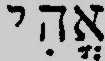
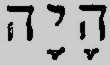
Chapter 1, the Hebrew verb 27 times. In verse 2 once, in verse 3 twice, in verse 5 twice, in verse 6 twice, in verse 7
once, in verse 8 twice, in verse 9 once, in verse 11 once, in verse 13
twice, in verse 14 twice, in verse 15 twice, in verse 19 twice,
in verse 23 twice, in verse 24 once, in verse 29 once, in verse 30
once, and in verse 31 twice. In 22
of these instances the
Septuagint has employed some form of the Greek verb of of these 5 cases the
verb towards the future. Thus in verse 6 where the Hebrew has,
"And let it be a divider between,
etc....", the Greek has used the future of The sense in all four
instances is "to serve as" or "to serve for", and not simply "to
become" and although the meaning is similar, it is not precisely the same.
We have here not a change in fact, only in function, a
circumstance which is recognized by Lexicographers. In verse 14 the Hebrew has
adverse of critics of the
present thesis would be allowed to mean "become" since
the verb Septuagint has
forms as verse 6. The same
is precisely true of verse 15 where, as inverse 14, the
have been rendered
"Let them become as lights....", the Septuagint again uses the form of
command - either a straightforward
future sense or a form of command (once again the
simple future of the verb
"to be", meaning either "let it be...." or "it shall
be...." Now this, then, accounts
for all the occurrences of the verb save one, and this
exception occurs in verse 2. Here, for reasons which are worth
considering, they made an exception. But just to show how really
exceptional this case is, it may be well to note in summary
that, excluding these occurrences of the Hebrew verb which are strictly future
or in the imperative mood, ie., verses 6, 14, 15, and 29 (all of which
have been rendered in the Authorized Version as "Let it be
for", "Let them be for", "It shall be for...."), the Septuagint scholars
uniformly rendered verb as meaning
"become" and not as a simple copula. Thus there is only one case out of 23
occurrences of the verb have made an exception and
treated it as a copula, translating it in verse 2 as
of Gen.1.2 as
stance strongly
influencing Jerome as he produced the Latin Vulgate which in turn served as a
basic guide in many cases to all the other Western versions from the
Authorized to the present day. As a consequence, the Universe
appears to have begun as a Chaos. Now the word Chaos
had a rather special meaning in Greek thought. It did not necessarily
signify what we mean by a situation which has become so badly disrupted
that it is a ruin. The Greek concept tended rather to mean only
the infinity of space: not an engineered dis-order but an early
stage of development before order had been imposed on the
Universe. The opposite of Chaos is
Cosmos. The first stage in the
development of the Cosmos was therefore being presented as a stage
of total emptiness - and this total empti- ness was termed
Chaos. In Appendix II it will be
seen that Ovid defined it as, "Rudis
indigestaque moles", ie., "A shapeless mass unwrought and
unordered". Webster defines
Chaos as, "The void and form less infinite;
the confused, unorganized state of primordial matter before the creation
of distinct or orderly forms". But this interpretation of the word
was a later one, held only by Roman authors and not by the Greeks, and
when the Septuagint was being written, the word Chaos almost
certainly still bore its more ancient meaning, ie., the infinity of empty
space. In time it came to be viewed
as not so much empty space
but as unorganized matter. Thus it is not really too
surprising that the Jews who formed the translation Committee
of the Septuagint and who knew too well that the Version they
produced was to take its place beside the lit- erature of Greece in the
great library at Alexandria, should seek, but without actually
distorting the Hebrew text, to make it possible to look upon it as a reflection of
the same basic cosmogony as was commonly accepted at that time. Yet
they did NOT, be it noted, actually use the word Chaos as a translation
of the Hebrew tohu where it might have seemed the obvious
thing to do if this is how they saw the earth's condition in verse 2. I
think their use of term s other than the Greek word Chaos is a
significant indicator of their view of Gen. 1.2. That the words in Gen. 1.2, however, have a very different meaning from the Greek Chaos or
the modern "nebulus", is shown later (in Appendix XVI) and it seems likely to me that the Jews in Alexandriawere quite aware of this. So they left the meaning “open” by a
transliteration which was
true in part but not the whole truth and could be interpreted by
the reader with some freedom to adjust the meaning to his own
particular preconceptions. The earth was a "chaos", whether initially or as a consequence of some intervening event it is not
specifically made clear in the Greek version, even though they did as shown
above, use between verse land verse
2. It may be argued that a Jewish reader would not necessarily see
such a significance in the use of many commentators have
done since, including Jerome. Yet Onkelos evidently did, for
he viewed the situation as a Chaos, not in the Greek sense but in the
more modern sense, a destroyed rather than a
waiting-to-be-ordered world. In
conclusion, therefore, in Genesis chapter 1,
wherever a becoming, the Septuagint
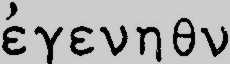
has in all but one case (22 out of 23) used the Greek important to note that the
verb
ing from their normal
practice in verse 2. Now according to my count
the Septuagint rendered some 146 times in Genesis
alone: in Genesis and Exodus together, 201 times; in the Pentateuch,
some 298 times; and in the whole of the Old Testament, close to
1500 times. Since the Old Testament uses the verb
half its occurrences the Septuagint considered the correct
sense to be "become". A very large number of the cases
where refer to the future as a
changed circumstance where, as we have seen, it is necessary
to introduce it since it is no longer merely copulative: quite properly
this demanded in Greek the simple future of the verb "to
be". On a fair number of
occasions the Septuagint has taken the Hebrew
original and paraphrased it, rendering the verb "to be" followed
by some other verbal form as a single verb which comprehends the composite
of the Hebrew original. I do not know exactly how often these
two situations (future tenses and paraphrastic renderings) occur, but it
must account probably for a fair percentage of the balance of
appearances of the Hebrew verb 'those instances in which
the Hebrew verb appears as an imperative, and those in which it has
the meaning of "existing" (ie., living), we shall not be far wrong if
we conclude that in the great majority of cases the Septuagint did
not look upon the meaning of the Hebrew verb as mere "being"
in the copulative sense but as "becoming" or "coming
In summary, I think it is
safe to say that by the Septuagint as
meaning "is" or "was", and that their rendering of it in Gen. 1.2 as
the accepted cosmogony
held in Alexandria and by the Greeks gen- erally . For such a
conflict would have appeared, had they translated Gen. 1.2 as "But the
earth had become unorganized....", since this clearly implies that it
had not been so in the beginning. We have already made
reference to the Targum of Onkelos, but in order to make this Chapter
more or less complete in itself, a brief review of what this Targum
represents may be in order. The word Targum,
(from Ragamu, "to speak", in certain Semitic languages) is a term for
the Aramaic versions or paraphrases of the Old Testament which became
necessary when, after or perhaps during the Babylonian
exile, Hebrew began to die out as the common language of the people and
was supplanted by Aramaic. The first evidence of a Targum as an
already existing body of accepted Aramaic paraphrase has been found by
some authorities in Neh. 8.8. Accord- ing to tradition, Ezra and
his coadjutors were the original founders". There grew up a certain
accepted rendering into Aramaic of parts of the Old Testament which
assumed something of the status that the Authorized Version did in
the seventeenth century in England. The Mishnah or official
Commentary of the Jews on the Old Testament soon contained a number of
injunctions respecting the "Targum", but for many centuries it was
preserved orally and not written down. All that is now extant of these traditional "renderings" are three distinct
"Targums" on the Pentateuch, a Targum on the Prophets, Targum son the Hagiographa
(Psalms, Job, Proverbs), and the five Magilloth (Song of
Solomon, Ruth, Lamentations, Esther, and Ecc- lesiastes), another Targum
on Esther, one on Chronicles, one on Daniel, and one on the
Apocrypha. The most important of the three Pentateuch Targums is named after Onkelos, probably a
corruption of Aquila, a proselyte and one of Gamaliel's pupils. Aquila's Greek version became so popular that the Aramaic version
current at the time was credited to him. It appears that this
Targum originated among the scholars of Rabbi Akiba between 150 - 200
A.D. in Palestine. It was later sent
to Babylonia where it was
modified and edited and vowelled in the Baby- lonian manner about 300 A.
D. Hence arose the Babylonian Targum. The oral tradition
behind it may therefore be traced to about 150 A.D. , but it could in
fact be considerably earlier. Hence
at or about this time we have an
Aramaic version of Gen. 1.2 which reads
the earth was destroyed", where the Aramaic verb has the meaning "to cut",
"to lay waste", or "to destroy", a rendering reflected in the traditional Midrash
interpretation quoted from Ginsberg (see page 14 above). The next version to be
examined is the Vulgate. Jerome, or more accurately, Sophronius
Eusebius Hieronymous, its author, was born in the city of Stridon
on the borders of Dalmatia and Pannonia, some time between 331 and
340 A.D. At about the age of 20, he was sent to a Rom an school
where he studied the classical authors under Aclius Donatus. He later attended the University at Trier
and Aquileia, where he studied
theology. After a tour of the East which ended in 373 and after a
severe illness, he adopted the ascetic life and spent four years in the
desert near Antioch where he studied Hebrew. He was ordained in
379 and three years later visited Rome on official ecclesiastical
business from Antioch. In Rome he began his work on the translation
of the Hebrew and Greek Scriptures into Latin. This great work was
completed before he died in 420 A.D. and since that time
remained in use throughout the Roman Church. Of chief concern here is his rendering of
the verb in the first chapter of
Genesis. In his translation he
consistently has factum (or facta)
est (ie., "became") wherever the Septuagint has
"The earth, however, was....",
thus faithfully reflecting the Greek version. Whether he really
was governed in this by what he found in the Septuagint or was
independently convinced that he was correctly translating in each
instance, we shall, of course, never know. But this much at least can be
said: once he had passed beyond verse 2, he had no hesitation
thereafter in equating the meaning of the Hebrew verb
in 13 occurrences in the
first chapter of Genesis alone. His depart- ure from this general principle
in verse 2 thus seems odd and looks suspiciously like a
Septuagint influence. Now, if we allow that the
term "Version" really means nothing more than "Translation
into a different language", we have another non-English
"Version" that may be allowed to bear its independent witness - and this is the
New Testament wherever it quotes the Old Testament. For here the Hebrew original is translated by inspiration (I believe)
into Greek. According to the Oxford Cyclopedic
Concordance, there are 277 quotations from the Old
Testament in the New, which are more or less exact. There are, of course, many inexact
quotations or
allusions and many incidents referred to, but these are not sufficient- ly exact as to wording to
allow the drawing of any conclusions about equivalent verbal meanings
within the two languages. Of these 277 quotations, only 29 are of such a form that the verb "to be" is an
essential part of the English rendering in the Authorized Version. In one case (No. 5 in the list below) the
situation is confused by the fact that
the New Testament uses a different sentence structure. Of the 28 quotations remaining, the Old Testament in 20 cases omits the verb
meaning is copulative.
This leaves us with only 9 clearcut examples upon which to attempt the
formulation of some kind of guiding prin- ciple. The number is far
too small to allow of any certainty - yet there seems to be some
measure of consistency. To begin with, here are
the 29 quotations. (1) Matt.23.39 (Mk. 11.9):
"Blessed is He...." Psa.118.26: identical -is is omitted in Hebrew. (2) Mk.10.8: "They
shall be into one flesh" ( So also LXX. Gen. 2.24:" They shall become....", (3) Mk.12.29: "The Lord
our God is one Lord...." ( So also the LXX Deut.6.4: In Hebrew, is is omitted. (4) Lu.4.18: "The
Spirit of the Lord is upon Me...." Isa.61.1: In Hebrew, is is omitted. (5) Lu.19.46: "My
house is the house of prayer...." ( "shall be"). Isa.56.7: "My house shall be called...." (different
verb used). (6) Lu.20.17 (Matt.
21.42): "The same has become the Head of the corner", ie, so also the LXX. Psa.118.22,23: "Has become, as it were, the
head....", : (7) Jn.10.34: "I said
ye are gods...."( Psa.82.6: "I said, gods (are) ye....", no
verb in Hebrew. (8)
Acts 13.33: "Thou art My Son" ( Psa.2.7: "Thou, My Son", no verb in Hebrew. (9) Rom. 3.10: "There
is none that...." ( out). Psa.14.1,3: "There, no God.....", Hebrew omits verb throughout.
(10) Acts 1.20: " And
let his... become....(
shall there be.... ( Psa.69.25: "Let it become that
their habitation be a deso- lated one.... and no one shall become a dweller in their tents...."
... ..... (11) Acts 7.32, 33: I am the God of
your fathers...., ....is holy ground...." Exod.3.6: verb omitted
in both clauses. (12) Acts7.49.50: "Heaven is my throne...." Isa.66.1: verb omitted throughout. (13) Rom. 3.13-16: Verb is is omitted throughout. Psa. 5. 9 and 36.1: verb omitted throughout. (14) Rom.4. 7, 8: "Blessed are they whose sins are forgiven... covered". Psa. 32.1,2: verb omitted in both cases. (15) Rom.4.18: "So shall thy seed be...." Gen. 15.5: "So shall thy seed become...." .... (16)
Rom. 11. 9, 10: "Let their table be as a snare.... ( Psa. 69.22: ".... become before them as a snare...." .... (17) I Cor. 6.16:
"They shall be (
( Gen. 2. 24: ... (18) I Cor. 10.26:
"The earth is the Lord s...." Psa. 24.1: Hebrew verb omitted, (19) I Cor. 15.54:
"Death is swallowed up... where is thy vict- ory?" Isa. 25. 8: Verb omitted
in Hebrew. The quotation reads slightly differently in Hos.13.14: I will become thy ( ( quote from the Old Testament to the New Testament: where the Greek has "Where, oh death, is your victory?" (20) Gal. 3.13: "Cursed is every one that
hangeth...." Deut.21.23: Verb omitted in Hebrew. (21) Heb.1.5: "Son of Mine, art Thou..."(
Psa. 2.7: Verb omitted in Hebrew ("My Son,
Thou....").
(22) II
Tim.2.19: "Those being of Him...."(
Num. 16.5: Hebrew omits
verb. (23) Heb.1.5: "I will be to him as a Father...." II Sam. 7.14: "I will
become to him as a Father...." .... (24) Heb. 1. 8: "Thy
throne is forever...." Psa. 45.6: Hebrew omits the verb. (25) Heb.2.6: "What
is man that..."( Psa.8.4: verb omitted. (26) Heb.5.6: "You, a
priest..." ( Psa.110.4: Hebrew omits
verb. (27) Heb. 9.20: "This
is the blood of the Covenant...." Exod.24.8: Hebrew omits
the verb. (28) I Pet.1.16: "Be
ye holy...." ( Lev. 11.44: "Become
ye holy (imperative) for I am holy..." .... This is an important illustration of the prin- ciple. The people were
to become what God is. Thus the verb second case. (29) I Pet.1.24: "All
flesh is grass". Isa.40.6: Hebrew omits
the verb. Of these examples as already observed, nine only [ie. , Nos. (2) (6), (10), (15), (16),
(17), (19), (23), and (28)] involve the verb
in the Hebrew of the text
of the Old Testament. From this
small body of information the
following "rules"* seem to appear: RULE N0.1. From the five references
numbered as (2), (6), (16), (17), and (23) it
appears that where in the Hebrew the verb
is employed followed
by use either the simple
future of the verb "to be" [in (2)
in (23)
seem that the best English
literal rendering for both the Hebrew and the Greek, where
* It is virtually
certain that these rules will prove to be totally inadequate but
at feast they make a starting point, and nothing more is
claimed for them than just that.
would be "as it were" or "in effect". Thus: (2) and (17): "They
shall become, as it were, one flesh". (6): "He shall become,
as it were, the head of the corner". (16): "Their table,
let it become, as it were, a snare". (17): "They shall
become, as it were, one body". (23): "I will become
to Him, as it were, a Father". In each instance the thought expressed is that the end result shall be analogously
such-and-such. Thus in (2) and (17)
the man and wife do not literally
become one body but only analogously. It cannot have reference to the fact
that children are to be born who will bodily sum up the parents because
many couples are childless and yet are so united as to fulfill
the real conditions of "oneness" which is to be the hallmark of a true
marriage. In (6) a man shall become
in effect a stone, the stone
which is the key to the stability and com- pleteness of the rest of
the building; meaning surely that the Lord will analogously be
a corner stone - not in actual fact: and in (16) a table is to become a
snare, but only in a manner of speaking.
And in (23): "I will
become, as it were, Father to Him" is a very signif- icant statement for it
implies that there is a special meaning to this Father-Son relationship,
and that this relationship cannot be precise- ly spelled out in
reference to the merely human situation.
No human son exists until he is
begotten of his father, whereas the Lord's relationship to His Father
was something far more than this. Thus, in each of these
cases, there would seem to be an important reason for using the
verb over, there is a change
involved. In many instances in the
Old Testament there is a
change of state, and in many there is a change of status. Stars are to
become time-setters, a woman is to become a man's wife (cf. Gen. 20.12),
a river is to become blood.... , and so on. The rule here, then,
seems to be that change is more analogous
than real. The stars remained stars, the woman a woman, the river a
river: each achieved a new significance. RULE NO.2. In three cases, (10), (15), and (19), the Old Testament uses
analogy is not in view,
but a real "conversion" into something diff- erent. Thus: in (10), a habitation will
literally become a desolation. in (15), Abram's seed
(singular) literally becomes a great host (plural). in (19), God the Creator
will become a Destroyer, of Death.
These
passages lend weight to the contention that while
sistently implies a change
of state (or status), the addition of
a distinct nuance to the
sense in which the "becoming" takes place. That is, it takes place
only in an analogous sense, whereas without the following
it is "becoming"
in a more literal sense, a transformation of one thing into another, not
"as it were" but absolutely. We have now accounted for
8 out of the 9 occurrences marked off for consideration. The ninth case (28) is readily disposed
of, the clear intent of the text
being to indicate a command and the verb in both the Hebrew and the
Greek being required to make the Imperative clear. Thus it seems reasonably certain that whenever the simple cop- ulative use of the verb
"to be" is involved, the Hebrew omits
though the Greek does not
always follow the same rule. However, the Greek does show
that if of the passages quoted in
the New Testament, some specific method must be adopted to convey
a precise meaning which is always more than the mere copula. We may observe that either a future is involved, or a command, or
the sense of "becoming", which thus demands the use of the
verb borne out even in those
indirect quotations so far examined. Thus in Rom. 9.29 for example: "(Except the Lord of Sabaoth had left us a seed) we also had
become ( om...." The original, Isa.1.9, has:
"We would have become as Gomorrah (as to) our likeness". In summary, then, on the
basis of this admittedly meagre sample, it appears that wherever
in the Old Testament no change of state or status is intended or
implied or commanded or predicted, the verb
implied or commanded or
predicted, the verb is expressed by some form of
upon whether the
transformation is viewed as analogous or real. The New Testament in
rendering the Old Testament quotations into Greek seems to have
followed this rule. It is also clear that in the 20 cases where the
verb ulative, a fact borne out
by the New Testament Greek which either follows suite and omits
any verb or uses the simple present tense of the verb "to
be", ie. always the present tense is not
used but some other tense or mood is called for, the future involving
a real change from the present, as for example in (2), (15),
(17), and (23), or the imperative as in (28), the
Hebrew requires the
appropriate form of the verb
ed. It is, in short, a rule according to the
testimony of these 29 quotations that Hebrew does
not employ the verb and that whenever it does
employ it, it is to convey the future, a command, or the sense of
"becoming". Finally, we may turn to one
further form of evidence, namely, the translations which have
been made of the New Testament into Hebrew. Of those made by Ginsberg
and Delitzsch, Heward observed: "It is important to
see that the Kal or simple conjugation of the verb
standard Hebrew translations
of the New Testament the Kal is employed by the Greek
half the occurrences in
Ephesians and Colossians - and no other conjugation." Such modern versions of the
New Testament do not, of course, carry the weight of
inspiration, so that the usage in each particular instance has been
determined purely by human judgment. Yet it is important to see that here,
too,
taken as a proper verb for
the sense of "becoming". To attach this meaning to it most
assuredly does not impose a strain upon it. It is its most common, not
its least common, sense. I do
not have a Ginsberg or a Delitzsch
rendering into Hebrew of the New Testament. The version in my
possession was published by the Trinitarian Bible Society (London) with no
specific authorship ascribed to it. However, it is most probably based
on Ginsberg. Almost all English versions stem ultimately from the
Authorized Version which formed their starting point, although
the "Modern English" versions owe perhaps least in this regard - and
a paraphrase such as Phillips' or The Amplified Version owe even
less, of course. But assuming that the New
Testament I have is the work of Hebrew scholars, we may examine it
with benefit in order to see to what extent the Greek
"became" is rendered back into Hebrew by use of the verb
cordance to the Revised
Version (not the Revised Standard Version, note) and from it was led
to the following passages, in all of which the Hebrew translation has
have "become". Matt. 18.3; "Except ye
be converted and become as little children....." Of which the Greek is "....
children", ie.,
John 1.12: "To them
gave He power to become the sons of God.....", "....
Hebrew is rendered:
with respect to God". John 9.39: ".... the
seeing shall become blind, and the blind shall
become seeing....", which appears in the Greek as
say, "those not seeing,
seeing, and those seeing becoming blind". The verb
being introduced but once
at the end of the sentence. The
Hebrew translation is:
blind shall become
see-ers and the see-ers shall become blind". It is quite true that if the
present thesis is incorrect, this could just as well have been
rendered, "the blind shall be see-ers and the see-ers be
blind", but we have the New Testament as a guide here - indicating that what is
intended is "shall become" not merely "shall be". And it is therefore to be noted that
Hebrew simply has no other way of expressing
the sense of "becoming" - nor is it required that the verb
is so often argued. On the
other hand, when a change of status IS involved,
becomes also an
apostle. "One must be ordained
to become a witness....", is in
the Greek,
with us to become"). In the Hebrew this has been rendered
thus: .....
from among us, one who
shall become with us a witness...." Thus was Matthias ordained and
numbered among the twelve. In the sense of
"happening to" someone, the verb
the Hebrew New Testament
in Acts 7.40, "We know not what has become of him....",
ie., know what has happened to
him". In Acts 7.52 there is an interesting
illustration of the difference between the merely
copulative use of the verb "to be" and that use which signifies a changed
status. The English reads: "Of
whom ye have been now the
betrayers and murderers". The
Hebrew translation omits the verb
before the word "betrayers" but inserts it before
"murderers": "Whom you (are) the
betrayers and have become, with respect to Him, as
murderers". It may be that the
verb is intended to serve for both clauses.... but
it may also be that a mere betrayer remains as he was vis-a-vis
society, whereas a murderer certainly does not, for his status has
definitely changed. At any rate, the
associated lamedh (
signify the special sense
in which they had become murderers - not by them selves laying hands
on Him but by having others perform the deed with their
authorization. In Acts 12.18 we have an
excellent example of the pluperfect use, in which the subject precedes
the verb. The English reads: "As soon as it was day, then a great
stir was there among the soldiers to see what was become of
Peter". In Hebrew this passage
becomes:
which, rendered literally,
would be: "(Came) the morning light and a great stir had there
come about among the men of war saying, What has become of
(ie., happened to) Peter?".
The dramatic effect of this sentence is
evident enough. Certainly the sense here is "to happen" or
"come about", and by paying attention to the word order one observes the use
of the pluperfect which adds to the vivid- ness of the whole
situation. In Rom. 2.25 the verb
and has the meaning of
"be made into" or "turned into", followed by
cision at all", ie.,
"thy circumcision is converted into un-circum- cision in
reality". This is a meaning
found in the Old Testament also, as in Exod.38.24, for
example. In I Cor. 9.22 and 23 the
Greek has
all things.... in order
that I might become a partaker of it". In Hebrew,
forms appearing as
" In I Cor. 13.11, "when
I became a man", ie.,
in Hebrew appears as
as a man" and thus
achieved the status of manhood, followed by
In II Cor. 5.21, speaking
of "achieving" the righteousness of God in Christ Jesus, the Hebrew
is meaning "In order that
we might become in Him as the righteousness of God". The lamedh
signifies a change of status once again. The Hebrew
In Gal. 3.13: "(Christ)
hath redeemed us from the curse of the law) becoming on our
behalf a curse...." appears in the Greek as
written as
our behalf a cursed
thing". Lamedh follows
indeed a change of status for the Holy One
of God. In Rev. 11.15 appear the
words, ".... saying, The kingdoms of this world have become
(the kingdoms) of our Lord". Here the Greek reads:
and the Hebrew has:
"saying, The kingdoms
of the earth have become, our Lord's". Now in the light of
Thayer's conclusion that to be confused with
"becoming", not
"being", it is a little surprising to discover that in the Authorized Version (as
indexed by Young's Concordance) the Greek verb
become" only 42 times.
However, an examination of those instances where the sense "to
be" has been given to this verb in the Authorized Version will soon reveal
that the rendering "become" would be equally valid, if not to be
preferred, in the great majority of cases. Indeed at the heading of this
list, Young himself gives the true meaning of the Greek verb as "to
become"! A few random cases
will reveal the validity of the above
observation. Matt. 5.45 (Young's first
entry) is given as "That ye may be the children of your
Father", which is clearly more correctly to be read as, "That ye may become
the children of your Father....", a state- ment exactly in accord with
Jon. 1.12. In Mark 6.26, "the king was exceedingly sorry",
means in point of fact that he became exceeding- ly sorry", for this is
what we really mean in such a context since it was a consequence of what
preceded. Luke 2.13, "Suddenly
there was with the angel...." is clearly a change, more expressively,
"suddenly there came to be with the angel...." John 4.14,
".... shall be in him a well of water...." is clearly, "....
shall always be in him a well of water...." And so forth. I do not say that it must always
be so rendered, for sometimes the sense
involves an imperative, for example. But in the majority of cases it
should be. In a number of instances
the range of meanings of the
Hebrew verb
verb
may mean "to
happen", "to come about", "to live" or
"exist" (as in I Cor. 2.3 for example),
and so forth. It has occasionally the mean- ing of "counting
for" or "amounting to". But it is very, very seldom indeed that
it possible that it is so
employed more frequently than the Hebrew
meaning is "to
become" just as by contrast the normal
meaning of
This is quite clearly
borne out by the lexicographers.
Thus Thayer gives its meanings
as: (1) "to become", "to come into exist- ence", "to begin
to be", "to receive being"; (2) "to become", ie.,
"to come to pass",
"to happen"; (3) "to arise" in the sense of
"appearing in History"; (4)
"to be made", "to be done", "to be finished";
and (5) "to become"
or "to be made" in situations where a new rank, or character, etc. , is
involved. This last is analogous to
the force of
a wife. It will be observed that
Thayer does not list in his five classes of meanings the simple
copulative idea -is, was, shall be, etc. On the other hand, he
expressly states that this is the prime significance of the Greek verb
the scholars who
translated the New Testament of the Authorized Version either were not
aware of the true distinction between
and
"becoming" in
English. If one examines Young's
list of occurr- ences under the word
"to be" as an English translation of the verb
ance) one finds that almost
always the verb in the Hebrew
version of the New Testament by strictly
"became". There are occasional exceptions. In Matt. 9.2 9 an entirely different
Hebrew verb is used ( be established for
you....", which is surely most appropriate. Another exception is in Matt
.16.2 where the translator of the Hebrew version must have
considered the word is in this verse ("when it is evening") as purely
copulative, for he has decided to omit the verb entirely. This could possibly be a case where
copulatively. But certainly such occasions do not seem
very frequent. Indeed, even in
Greek, the simple copulative verb is apt to be omitted where one
might expect to find it according to English modes of expression. When it is omitted, the Hebrew version follows suite - as in
Matt. 24.32 for example, "Ye know that summer is nigh....", or in
Matt. 24.37, "But as the days of Noah were...." In Matt.26.5 and 27.45 the
Hebrew translator took the sense as simply copulative and omitted the
verb the Greek. One must clearly bear in
mind that the Hebrew version of the New Testament is not an
inspired one. It constantly involved
human judgment. And although
perhaps the translator worked prayerfully
at his task, we cannot
expect of it the same inerrancy that we may expect to find in the
original Scriptures. I think we must
either assume that in such
seemingly copulative uses in the New Testament Greek we have in reality
something more than appears to the casual reader (in which case the
Hebrew version is not accurately interpret- ing the text) or we have
some cases where the normal verb "to become" is for some
reason being used exceptionally. It is possible of course, that our Greek
New Testament is itself a version, a translation of an original
Aramaic, at least where the Gospels are concerned, as Lamsda would
argue. From such examples* it would
appear that whereas in moving from Greek to Hebrew the Greek may
be viewed as copulative and will not be represented by any
corresponding verb, in moving from Hebrew to any other language it is
safe to interpret the absence of the verb
ulative. In short, in so
far as arguments have validity when based on a study of an uninspired
Hebrew version of the Greek New Test- ament, there is evidence enough
that the verb
employed in Hebrew when the
meaning is something other than the simple one of
"being". Thus even in the minds of modern
translators, but it is the normal word for "becoming"
and there is, in fact, no other way in which a Hebrew writer can express the idea
of becoming except by its use. Thus, in considering the
meaning of Gen. 1.2, we have two factors to take note of. If the verb
is merely copulative, the writer could have made this quite clear
by omitting it entirely. Then there would have be en no doubt about
it. But he did NOT omit the verb. On the contrary, there was no
other way in which he could have expressed the idea of
"becoming" and the presence of the verb should therefore be taken as having this
significance. It is no longer
sufficient to appeal to the old
clich that
by lamedh. The many
versions in English do not support this argu- ment at all. A quite
cursory examination of the Authorized Version shows 30 or more passages
in which
ered "became" or
"become". Indeed, in more than one third of the occurrences of
examination of the Revised
Standard Version shows about the same number of occasions, actually
about 25% of all occurrences of * Further examples will be found in Appendix XVII.
in the original. And the
even more recent Berkeley Version reveals ten cases in Genesis
alone.* Such lists do not include the numerous occasions where
preposition, such as
in the English
versions. Nor do these lists include
numerous occasions where the
meaning is clearly "became" in spite of the fact that no English version
currently available has indicated the fact: such passages, for
example, as Exod.23.29, "Lest the land become desolate......", or
Ezek.26.5, "It shall become a place for the spreading of
nets...." Thus, no special pleading
is required to establish the fact that the verb in Gen. 1.2 is
most unlikely to be a mere copula.
Those who decline to adopt this
principle of rendering than was are surely far more in danger of
attempting to "explain away" the original
text than are those of us who do accept it, for we are being guided by what
certainly seems from the evidence to be the rule rather than the
exception. * See Appendix XVIII
for lists of references to these Versions. # See Appendix X for
references.
Copyright © 1988 Evelyn White. All rights reserved
|

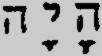 which is
otherwise
which is
otherwise
 occurs
 ie.,
"become".
ie.,
"become".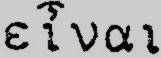 ,
, , "it
shall be...." This seems quite proper.
, "it
shall be...." This seems quite proper. (which even by the most
 which falls into the same class of verbal
 .
In verse 29 there is
.
In verse 29 there is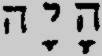 by the Greek
 so showing that they viewed it in this context
 ,
thereby presenting the reader with the opening words
,
thereby presenting the reader with the opening words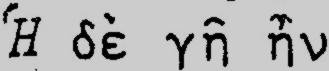 : ie., "But the earth was...." a circum-
 instead of
  for the particle
 is clearly indicative of a
change or
is clearly indicative of a
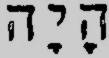
change or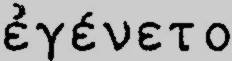 .
. is not to be equated with
 .
. is seldom considered
 was probably in order to avoid conflict with

 ,
and in verse 2 he has "Terra autem erat....", ie.,
,
and in verse 2 he has "Terra autem erat....", ie.,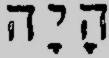
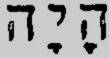 entirely, its use being not required since the
 ).
). with
with  .
.

 ,
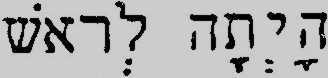
,
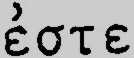 ), so also LXX.
 ).
).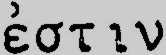 occurs through-
 ); neither
 ).
).

 ....
....
 ....)
....)
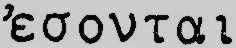 )..... (
  ) into
 .....)
  "They shall become as it were...."
 ).... plague, oh death....
 )
thy destruction, O grave". This is not an exact
)
thy destruction, O grave". This is not an exact ....
.... ....)
....) ).
). ...
...
 ..)
..) ..)
..) -imperative)
 is proper in the first but not in the
 , the New Testament writers were
led to
, the New Testament writers were
led to ,
and
,
and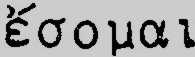 ]
or the verb "became" [in (6) and (16) -
]
or the verb "became" [in (6) and (16) -
 ,
, ]
followed by the preposition
]
followed by the preposition  ("into").
 appears
in the latter and
appears
in the latter and 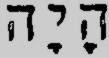 followed by
 .
.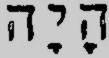 con-
con- adds
adds .
. ), as Sod-
 ie.,
ie.,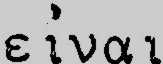 but never
  . When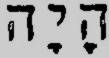


 ...."which is rendered into Hebrew "to become as (little).
 .
. .....", which in
 , ie., "to become sons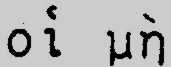
 ", that is to
 is perhaps intended to serve both clauses though
 , ie., "the
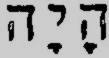 be followed by

 literally, "a witness of the resurrection of Him
 ie., "He was taken
 , ie., "We do not
 ie.,
ie.,




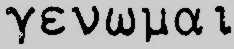 ..... : ie., "to the weak I became weak.... to all I became
 is here consistently replaced by
  twice, and
  once.
once.
 , ie., "and when I became
 ,
,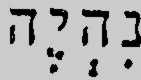 is for the Greek
  .
. .
. , ie., "in which he became on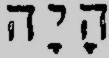

 or literally,
 is never
  in Greek since its proper meaning is
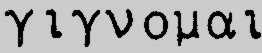 is translated "to be" some 250 times and "to
 where a change of
status is in view, as when a woman becomes
where a change of
status is in view, as when a woman becomes OR did not themselves distinguish between "being" and
 ) which means "let it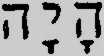
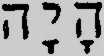 is followed,
not by lamedh, but by some other
is followed,
not by lamedh, but by some other , etc. ,# where it is still rendered as 'became'