|
|


Preface Introduction ChaptersChapter 1 Chapter 2 Chapter 3 Chapter 4 Chapter 5 Chapter 6 AppendicesAppendix I Appendix II Appendix III Appendix IV Appendix V Appendix VI Appendix VII Appendix VIII Appendix IX Appendix X Appendix XI Appendix XII Appendix XIII Appendix XIV Appendix XV Appendix XVI Appendix XVII Appendix XVIII Appendix XIX Appendix XX Appendix XXI IndexesReferences Names Biblical References General Bibliography |
THE LINGUISTIC EVIDENCE. "But the earth had become a
desolation...." The rendering above departs from that to be observed in almost all the better known
English translations in three ways:* the use of a disjunctive (but for
and), the use of the pluperfect in the place of the simple perfect, and the use
of became in place of the simple was. Of the disjunctive, little
need be said. The Hebrew stands for both the
conjunctive and the disjunctive particles, and the context alone can determine
which is the more appropriate. There is, as we have seen, some reason to prefer the disjunctive in view of the indicated pause in
the Hebrew text at the end of verse 1. In Appendix XIV will be found a
number of illustrations of this use, in- cluding some instances in
which the correctness of the disjunctive form is borne out not
merely by the obvious sense of the passage quoted but by its
reappearance as a quotation in the New Testament where the Greek has
"but", not "and" (ie., The use of the pluperfect is dealt with in the following chapter, the point being reserved for discussion only after the translation of the verb itself has been
carefully considered. The most critical issue is whether * See Appendix III. pg
1 of 19 the true significance of
the verb, and indeed of the second verse as a whole, hinges upon the settlement of this point. Granted that this point can be settled, the
other two points will probably not be ser- iously disputed. Now this discussion does
not make easy reading, not only because of the subtleties involved
(as will appear) but also because the verb we must examine in its
commoner forms happens also to be the very verb we must use in its
commoner forms in order to make the examination! One runs into this kind of
thing: "In such a case, the word was is incorrect....". Or
one might put this: "In such a case, the word "was" is incorrect...
."; or " the word WAS is incorrect"; or "the word was is
incorrect....". At any rate, this points up the nature of the problem! Thus we are forced to employ various
devices (underlinings, capitals,
italics, and 'quote' marks) in order to make each point clearer.* And this kind of constant typographical
switch- ing is most distressing to
even a thoroughly dedicated reader. But it seems unavoidable. In view of the fact that
one can scarcely construct an English sentence of any complexity
without using some form of the verb "to be", it is difficult
to realize that there are well-developed languages which make little or no
use of it at all in the simple copulative sense. When, in English, we
express the straightforward idea, "The man is good", the verb
"to be "is used merely to connect together the words man and good. Many languages, and indeed many children,
simply say, "man good",
considering the connective verb quite unnecessary. A child will say, "Me
good boy": an Indian might say, "Me brave man". Hebrew does the same. Benjamin Lee Whorf, the
'founder' of that branch of the study of language known as
Metalinguistics, observed that a Hopi Indian, for example, has difficulty in
understanding why we say, "It is raining". because to his way of
thinking the It is the rain.
One might just as well say, "Rain is
raining" - which of course is a redundancy. So he wonders why we don't
simply say, as he does, "Raining"! Neither * In the biblical quotations
which follow, we have tried to indicate to the reader
where the verb "to be" has been supplied in the English
though absent in the original by put- ting the verb in
brackets. Thus: Gen. 3.11,
"Who told thee that thou (wast)
naked?" indicates that (wast) has been supplied to complete the
English sentence.
the It
nor the Is serves any useful purpose in this English sentence and common sense,
therefore, would argue the leaving out of both of them. But this would not sound correct to
us. Yet, as we have observed, Hebrew shares
the un-English view that a verb is not needed here since it
really contributes nothing. Now, in translating, it is
quite customary to equate the Hebrew verbal form by Hebraists for many years that the
equation is not strictly valid. In English, being
is a kind of static concept, things simply "are" this or that. When we say,
"The man is tall", we are not speaking of a dynamic event but a
more or less static situation.
"The field is flat" is indeed a
static situation. In both these
sentences English requires some part of the
verb "to be" in order to satisfy our sense of linguistic
propriety. Yet in spite of the
possession of the verb necessary here and the
verb is would therefore not be represented in the Hebrew. The reader who is limited
to English will find that in some editions of the Bible, especially
in the Authorized Version, a means is prov- ided, simply by the use of
italics, to show where any part of the verb "to be" has been
inserted in the English translation to complete the sense though not found in
the original Hebrew. For example, if one opens a first edition of
the Scofield Bible at (say) page 21, some eleven copulative or
connective occurrences of the verb "to be" will be found in italics,
appearing in the text as is, art, be, and was:
and on page 395 some 39
examples will be found in the forms was and were In every instance the word
has been supplied by the translators where the Hebrew original did
not consider any verb necessary.* * Any page would, of course, have
served to illustrate the point, and any
printing of the Authorized Version will show it. Thus, for example from Jud. 6.10 to 7.14
we have in 6.10 am, 13 be, 15
am and is, 22 was 24 is, 25 is, 30 be; and in 7.1 is, 2 are and are,
3 is, 12 were, 13 was, and 14 is. All these are copulative and the original. On the other hand, in Judges 6.27 the verb was is not in italics since it is found in the Hebrew, and it is clear that the
intent of the writer was something beyond the mere copulative
force of the verb: as for example Continued
page 44. Thus the fundamental idea
behind the Hebrew verb cisely what would be copulative in English
but is a far more dynamic concept. This is indicated to some extent
by its possible etymology. A number of authorities,
including Gesenius and Tregelles, believed that the primary meaning
was that of "falling" - comparing the word with the Arabic From this came the idea of
"befalling" in the sense of "happening", and so "to fall
out", and thence "to come to be", ie., "to become". From this idea of having
become, we pass easily into the meaning "to be" in the sense
of having existence but the copulative sense usually attributed to it
seems without logical foundation. Subsequently, Tregelles
came to believe that the concept of "fall- ing" was not really primary,
and that the notion of "being" came instead from that of
"living". From the concept of "living" the idea of "being" is
readily derived so that it comes easily to mean "to be": but this kind of being is
dynamic being, living being, not the static kind of being which is
equative as when one says, "This is (ie., equals) that", but the kind
which is implied in such a sentence as "He is alone", or "He
is with thee". Thus while Benjamin Davies
gives the basic meaning as "to be" - usually with the sense of
"to exist", "to be alive", "to come into being", and so
"to become" - Brown, Driver and Briggs list the meanings of "to become"; and
"to be". And under the
last heading they add subsequently in parenthesis, "often
with the subordinate idea of becoming". The concept of dynamic as
opposed to static being is of great importance to an
understanding of the Hebrew usage of the word. Boman, in a critical study
of the verb, concludes that it is never used copulatively at all
and that all the usual illustrations of such a use provided in lexicons
are not really valid. He does not consider that even Ratschow, who
made a quite exhaustive study of Old Testa- ment usage, was really
able to give any clear unequivocal instances. Thus, for example, in Gen. 2.25 the
sentence, "and they were "And it came to be that...." In Gen. 23.17 the verb 'to be'is set in italics 5
times! We need this insertion of
the verb to fill out the
sentence, but the Hebrew writer did not see any need for it and so
omitted it entirely. ( at the moment of speaking
the writer is observing the simple fact of their nakedness but that
this was how they lived, daily. They "went about" without
clothing and without shame.
Subsequently, they suddenly became aware that
they were naked and this awareness brought with it a sense of
shame not experienced before. This
was nakedness in a new way and
it occurred quite suddenly - suddenly enough that Adam
"discovered" it with a sense of shock. That this was in the nature of a
discovery is implied in the Lord's words (in Gen, 3.11), "Who told
thee that thou (wast) naked?". The question would have been pointless
otherwise. Thus the real emphasis here is no longer upon the
circumstance that Adam and Eve had been living naked in the Garden of
Eden but that they had both suddenly discovered a fact which caused them
to be ashamed. Boman argues that the
simple "is" or "was" in an English sentence is never expressed in
Hebrew and that where it IS expressed it does not mean what the English
translation implies. It is used in the sense of eventuality: it is not
used for a simple fact or circumstance or situation. One might wonder how Hebrew would then
distinguish between the phrase, "the man is
good", and "the good man".
In a sense they convey the same basic
idea, but there is a subtle difference. In any case Hebrew can make the
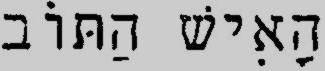
distinction. The first would appear simply as "the man
good" (ha-ish tobh: as "the man the good
one"(ha-ish ha-tobh: One might then ask further, How would the
distinction be made between the sentences,
"the man is good" and "the man was good"? In Hebrew, the context is
allowed to decide the matter. While
it might seem that this would
be difficult (as upon occasion it is), the number of such occasions
must be remarkably small for there seems to be not the slightest
hesitation in omitting the verb, whether the sense of "is" or
"was" is intended. Such will be apparent from the footnote with examples on
page 43 of this Chapter and from the more elaborate study which will
be found in Appendix IV. Some have felt this to be
a real difficulty. Barr, for
example, argues that the verb must
be inserted when the tense is past and the situation no longer exists.
For example, if a writer meant to say, "The man was good....
but is no longer so", ie., "The man was once good", then he
would insert the appropriate form of the verb "to be" to indicate the
altered circumstance. But this rule does not hold. For example, according to this principle, the record of
Job's complaint in Chapter 29 should have
the verb was
in the original since the situation has clearly been altered by his diseased condition.
Yet, in point of fact, the Hebrew omits it. It is not merely
that the situation is no longer true today: the situation was no
longer true when the statement was made. Thus Job, inverses 14 and 15
and 20, tells his self-appointed comforters that he was formerly -
ie., was once - a father to the blind and feet to the lame: he once
enjoyed fame and recognition and his roots once spread beside the waters
like a flourishing tree. The meaning
of his complaint is
unmistakable. He WAS all those things but is no longer so: yet the Hebrew
writer saw no need to express the connect- ive verb "was"
in such a situation. We have another example in
the case of Pharaoh's servants in Gen. 41. Here the butler recalls (verse 12) how he
and a fellow tradesman were in prison
and how at that time a Hebrew named Joseph was also with them.
Clearly the situation had now changed for the speaker, since he
is a free man - and his fellow tradesman is dead. He refers back, therefore,
to a situation which from his point of view no longer
exists and the English translation in verse 12 properly inserts the verb
"was" - but the Hebrew omits it.
Some might argue that the
situation for Joseph had not changed, since he was still in prison! But
one must surely consider the circumstances from the point of view of
the speaker. The omission of the verb in reporting his speech
shows, therefore, that it is not required merely because there is the
implication of altered circumstance. He was, as he says, once in the
same prison: but he is no longer so, yet the Hebrew writer evidently
saw no need for the verb There are numerous
illustrations of this kind of situation in the Old Testament, but many of
these require a somewhat elaborate excursus in order to show
how we know there has been a change. Some are straightforward enough: as, for
example, where Gen. 12.6 records that "the
Canaanite (was) then (ie. , at that time) in the land". But there are probably far more examples
which are in reverse. There are innumerable examples where the
situation is quite UN-changed and yet
the verb "to be" is inserted in the original in the appropriate
form. This is a most common occurrence. Thus, for example,
throughout the first chapter of Genesis there is the recurrent phrase,
"And it was so". Here the
Hebrew inserts the verb. According to Barr, this insertion should
imply that the situation or circumstance is
no longer true. But this is surely not the case. Genesis 1,
verses 3, 5, 7, 8, 9. and so forth, would all be properly translated if
one were to render the phrase which in English reads, "And
it was so", as "it became so", but it would
surely be quite
improper to suppose that the author means, "And it was once but is no longer
so....". Thus, the insertion of the verbal form
"was" in a Hebrew sentence is not intended to signify
that the circumstance is no longer true, for these evenings and these
mornings retain their pre-eminence of position in the processes
of time. Thus when Barr proposes
that the verb is inserted in
Gen. 1.2 in order to show that the desolation was a temporary one and no
longer exists, he is implying the existence of a rule which certainly
cannot be unequivocally demonstrated from biblical usage. And to say
at the same time, as Barr does, that on this account "it would
be quite perverse to insist on the meaning 'became' here", is
clearly going beyond the evidence. Indeed, he would perhaps be forced to
admit that to follow out his own proposed rule and render Gen. 1.5,
"and the evening and the morning were once a second day but are
no longer so", would indeed be absurdly perverse! But, by contrast
to this absurd rendering, it would make very good sense to
render the Hebrew, "and the evening and the morning became the second
day", for this is precisely the truth of the matter, and the Hebrew
has seen fit to insert the verb in order (as I believe) to make
this quite clear. In this eventful
period, it did become the second day
of the week. From all of this it would appear
that the decisive factor which determines whether the verb will be
inserted or omitted is not related to tense. Nor is it related to circumstance, if by
this is meant merely that what is
reported is no longer the case. Boman seems to come much closer to the
truth when he underscores the fact that only where the sense is
dynamic does a Hebrew writer introduce the verb rounding its employment
which bear out the contention that it is basically a verb of action
rather than condition. First of all it can be, and frequently is,
used in conjunction with the infinitive or a
participle of another verb of action. For example, Nehemiah (2.13) tells how he
was in the habit of inspecting the walls of his beloved city
Jerusalem while they were still under repair. Thus he says, "And I
was ( walls of
Jerusalem". This could easily
have been expressed by the appropriate form of
the verb engagement.... A list of examples
will be found in Appendix VIII and a study of such usages
indicates that the idea is best expressed by rendering the verb or phrase as "kept
---" (Ezek.44.2), "succeeded in ---" (II Chron.
18.34), "remained
---" (I Ki. 22.35), "continually---" (Gen. 1.6), "habitually ---"
(I Sam.2.11, Gen.39.22), "was ever ---" (I Ki. 5. 1), "always ---"
(II Ki.4.1, Ezek.44.2), "was daily ---" (Neh. 5.18), etc. All these
imply something beyond a static situation, even in Ezek. 44.2, for the
idea is positive closure of the gate, that is, keeping the gate closed
and not merely "leaving it shut".
It is a case of maintenance rather
than abandonment. In II Chron. 18.34 the mortally wounded king
obviously did everything in his power to hold himself upright in
his chariot so that his supporters would not lose heart.. In Gen. 1.6
the atmosphere actively divides, ie. , main- tains, the division between
the waters above it and those below: there is nothing static about
this process at all. And so it will
be found in every instance of usage
in connection with either a participle or an infinitive. It is analogous to the English usage in such
a sentence as "the water is
boiling" or "the man is still angry". Secondly, it appears in
the niphal or passive form, as though the sense was "to be
be-ed", just as in English an active form (e.g. "fold") is
converted to a passive form* ("fold-ed") by the addition of "-ed". It is
much more difficult to think of the English verb "to be" in a passive form because
to us it tends to be essentially a static concept. In Hebrew, since
it is an active verb, the formation of a passive did not seem strange
and the verbal form of the active is routinely changed to a
passive form without hesitation.
Thus in I Ki.l. 2 7 a literal
translation would be, "Is it from my lord the King that this thing has been
be-ed" (!), which would obviously have to appear in English as
"has been done" or "has come about" (in Hebrew : of action. Similarly, that
often quoted passage from I Ki. 12.24 (lit- erally, "For from me
this has been done" ( is in the Authorized
Version, "For this thing is from me". Most lexicographers simply say
that in the niphal or passive form the verb is best rendered
"come to be", ie., "become" or "happen". This is the sense of Deut. 27.
9 for examples "This day ye have become a people for the Lord your
God". Boman's third point is
that the verb with other verbs, in sentences which have a
clearly active context. For example, in Gen. 2.5
it is written, "Every plant before it was in the earth and every
herb of the field before it grew....". And, * See Appendix VII for illustrations.
significantly, this is
followed by the words, "And there (was) not a man to till the ground". In the first
instance the verb is used as a parallel to the verb
"grew"; and in the final phrase the verb is omitted because it is a statement
of a static situation rather than an activity. Another illustration of
this kind of parallelism is to be observed in Gen. 7.17,"And the
Flood was forty days on the earth", followed by verse 19 which says,
"and the waters prevailed exceedingly upon the earth". Clearly the picture is one of the
turbulence of an over- whelming flood and not
merely of a deep but placid sea of water. Boman suggests quite
properly I believe, that throughout the Creation record, the verb being" rather than
merely factual existence. God created, or spoke, or made, and "it came
to be so", ie., "sprang into being", certainly indicating an active
process of realization rather than a static cir- cumstance. Indeed, it is found in parallel with the
Hebrew which has the meaning of
"realization" in such passages as Isa. 7. 7 ("It shall not stand,
neither shall it come to pass") and Isa. 14.24 ("Surely as I have
thought, so shall it come to pass"). Now the verb It is a very versatile word obviously: and
only by associating it with various prepositions
( forms (infinitives and participles)
can its full range of meanings be set forth
adequately.* As Boman observed: " word which can me an
everything possible and therefore des- ignates nothing characteristic. Closer examination, how- ever, reveals that this is
not the case." Ratschow examined the
occurrences of with a thoroughness hardly to be excelled
and concluded that the verb had three essential meanings
which are given in the following order: "to become",
"to be" in the sense of existing or living, and "to
effect". Boman, in discussing
Ratschow's findings, states his opinion that these meanings really form
a single basic unity with an internal relatedness. In his discussion he first of all points
out something which was elaborated by Benjamin Lee
Whorf, namely, that the meanings people * See Appendix VIII for
illustrations. attach to the words they use reflect their own
views of reality, and that these views are not at all the same as those
generally shared by people of another language group. Many
non-Indo-European peoples tend to equate things which we would consider quite
separate and distinct.
For example, to say in English that something IS wood is not to identify the thing itself with the wood
that it is made of, but rather to say that it is made "out of "
wood. By contrast in many other languages, including Hebrew, the thing and
the wood are ident- ified, equated, considered as inseparable. Such a
sentence as "the altar and its walls (were) wood"
(Ezek.41.22) means to the Hebrew mind that altar, walls, and wood are a single
entity, an equation, one and the same in the particular instance. A verb is
not necessary. Similarly, "All the Lord's ways (are)
grace and truth" would mean to us that there is grace and truth IN all the
Lord's ways. But not so to the Hebrew mind. This is not an aspect
of the Lord's ways, it is a factual commonality. As Boman expresses it,
"The predicate inheres in the subject". Thus he further observes: "The most important meanings and uses of our
verb "to be" (and its equivalents in other Indo-European
languages) are (i) to express being or existence, and (ii) to
serve as a copula." But having said this, Boman comments: "Hebrew and other Semitic languages do not need
(my emphasis) a copula because of the noun clause
(such a clause as 'the altar is wood'). As a general rule,
therefore, it may be said that istic mark of it is a true verb with full verbal force." In short, he concludes that whether accompanying preposition or is qualified by one,
"it signifies real becoming (his emphasis), what is an occurrence or a
passage from one condition to another.... , a becoming in inner
reality...., a becoming something new by vocation....". Such
is Boman's view, a view supported by many illustrations, some of
which will be found later in this text. It is a view arrived at by a most careful study of the whole question in which cognizance has been
taken of the previous labours of a large number of recognized
European scholars.
It is a view which
completely contradicts the rather bombastic state- ments of some recent
writer s whom we have already quoted as saying in effect that every
Hebrew scholar knows precisely the opposite to be the case! It is a view
which strongly supports the argument that chaos was not the initial
condition of the created earth. Other linguists agree with Boman.
Non-Indo-European languages do not employ the
verb "to be" as English does. In an interesting paper entitled, Language
and Philosophy, Basson and O’Connor ex- amine the relationship
between structure of language and form of philosophy. This examination
includes as an important part of their thesis a study of the verb
"to be" used in the following ways: (1) As a logical copula, involving: (a) Predication: "the
leaf is green". (b) Class inclusion:
"all men are mortal". (c) Class membership:
"the tree is an oak". (d) Identity: "George
VI was king of England". (e) Formal implication:
"wisdom is valuable". (2) In an existential sense:
"God is". (3) In any other sense
peculiar to the language in question. "Some interesting and possibly important information was supplied to us (from a
questionnaire sent to a number of phil- ologists and linguists) on
this topic. Most interesting was the large number of
languages which made a sharp distinction between the existential
'is' and the copula.* Semitic lang- uages have in general no
copula, but Hebrew and Assyrian both have a special word
for 'exists'. Malay (an Austro- nesian language) is
similar to Hebrew in this respect. Tib- etan uses 'yin' for the
copula and 'yod' for existence, but a sentence like 'That hill
is high' might use either word accord- ing to the sense of the
context." All the lexicons deal with
the verb have in my possession, nor
is there available to me at the present, a copy of the original work
completed by that most famous of Hebrew lexicographers, Friedrich Heinrich
Wilhelm Gesenius, in 1812. I do have, however,
translations of his original work edited and amended in various ways by some of
the scholars who followed him. * See further Appendix
IX
Christopher Leo's edition of Gesenius,
published in 1825, gives a list of the meanings of
the verb with illustrative examples from the Old Testament which may be
summed up under the following basic headings: "to
be" illustrated by reference to Exod. 20.3 ( a curious circumstance since it is
not copulative!), "to serve as" or "to tend towards", "to
become" or "turn into" (with the preposition be with" (ie. , associated with, or on
the side of), "to happen", "to prosper" or
"succeed", and "to have happened". Tregelles' edition of Gesenius, published
in 1889, gives the follow- ing meanings: "to
be" or "to exist", "to become", "to be
done", "to be made" (all without
any associated preposition by modifying prepositions,
the verb is given an extended list of meanings which are
summarized in Appendix X. Since the
main point at issue in this
instance is the meaning of the verb where it is accompanied by no preposition
of any kind, the other passages will not be
examined at this point. In the
passive voice, Tregelles gives the
meanings as "to become", "to be made", and "to be done". In 1890 a Student's
Lexicon was published by Benjamin Davies, also based on Gesenius
(and Furst). He gives the basic
meanings as follows: "to
be" - whether with the meaning of "to exist" or "to live", or "to be
somewhere" - or as the logical copula between subject and predicate. As an
illustration of this last, he refers to Gen. 1.2. He then gives a second
group of meanings as follows: "to come into being", "to come
to pass", "to occur" or "happen"; and in the passive "to be done",
"to be made to be". In each of these Lexicons
I have examined every reference in the original Hebrew. In many instances the
appropriateness of the headings under which they
are listed can be very much a matter of opinion as is revealed by the
fact that the same reference will be reproduced under different
headings be different lexicographers. A list of these references
will be found in Appendix XI. I believe it would not be
incorrect to say that as these Lexicons appeared successively through
the years, the verb course of time viewed
somewhat differently. With Gesenius and Leo the principle or basic
view seems to have been that the verb meant essentially "to
be" in the ordinary English sense, with the concept of "existing" or
"living" next, and "becoming" only as a last alternative. By the time we come to
Brown, Driver, and Briggs, the modern standard of reference, the
position has altered. The basic mean- ings are now set forth under
four headings in this order; "to fall out", "to come
to pass", "to become", and finally, "to be". And
even with respect to this last alternative, at the
appropriate place the authors add in parenthesis: "often with
the subordinate idea of becoming".
Thus the emphasis has shifted: where the copulative sense was originally listed as the primary one, it
is now listed as of least importance. Brown, Driver, and Briggs' Lexicon of the Hebrew language is by far the most exhaustive
available in English and here we find that far from being a rare or
exceptional meaning of of "coming to be" or "becoming"
is one of the most important and most fundamental meanings. I have examined every reference given in all these Lexicons as well as those provided in some of the more
elementary student's dictionaries of Hebrew and I have no hesitation in
saying that the evidence tells unmistakably against the present
commonly accepted view among "conservative" biblical
scholars who have expressed an opinion on the meaning of Gen. 1.2. Some of these writers will argue that when, it is followed by the preposition lamedh
( untrue as is easily shown by a study of cases where "became" is manifestly the correct rendering of in the Hebrew. A list of examples where why – will be found in Appendix XII. I would not say that the verb is never used
copulatively (though Ratschow and Boman hold this to be virtually so),
but I think it can be shown conclusively that the simple copulative use
is the exception and not the rule, and that such exceptions are very
rare indeed. In a few cases there appear to be exceptions only because
we have failed to observe the real meaning that the Hebrew writer
had in mind and our renderings are misleading. As we have seen, the
verb can be used to signify an "active existence" in
a situation where we would not expect to find "activity". Such a
case as Adam's nakedness is an example, for this is how he "went
about". In this instance, the English simply says that Adam was naked. But in the Hebrew processes of thinking, this is not a static
condition but a living circum- stance. The Hebrew mind animated situations far
more frequently than we do and it is this animation which gives the
Psalms, for example, such tremendous dramatic force. Like many non-Indo- European people, they thought of things as
having character, not merely characteristics. Even in Brown, Driver, and Briggs the list of supposedly cop- ulative uses includes numerous instances where the
case is very doubtful. For example, they list Deut.23.15,
"The servant which is escaped unto
thee....". But surely this is
an instance where modern English would
require the verb has rather than is. It is not a copulative use of the
verb: the verb verb of dramatic
action. One could never properly
substitute the word "has" in
such a sentence as "The field is flat", and the very fact that one can make the substitution
in the former but not in the latter case is sufficient to
demonstrate that the difference is a real one. In such a sentence as Gen.
17.1 (also included in the list in Brown, Driver, and Briggs) where
the text reads, "And when Abraham was ninety years
old....", we are not really saying that Abraham WAS ninety years. Obviously
Abraham is not the same "thing" as ninety years. We are actually
saying, "When he reached the age of....", ie., "When he became ninety years
old....". Brown, Driver, and Briggs
list altogether 45 references to show that 8 should be excluded,
being clearly not examples of a purely copulat- ive use. Furthermore, I believe another 7 at least
are equivocal since in every case the
translation "became" or "had become" would be equally, if not more,
appropriate. These are: Gen. 1.2; 17.1; Jud.11.1; II Ki.18.2; I Chron.11.20;
II Chron.21.20 and 27.8. This leaves us with only
30 examples out of a total (included under all headings listed in their
lexicon) of 1320 occurrences of have been proposed as
illustrations of the possible meanings of the verb. Moreover, of these 30,
at least 8 others are ill-chosen be- cause their use is either
anomalous (Gen. 8.5) or signifies "came to be" as in
Gen.5.4,5,8,11; 11.32; 23.1; and Exod.38.24. As we have already said,
it seems possible that some cases of a genuine copulative use of the
verb most writers for the
passage in Gen. 1.2 will be discovered if the Old Testament is searched
with sufficient care. But the fact
that Ratschow was not willing, after
making such an exhaustive study, to admit of a single
instance, suggests that such cases will certainly be the exception rather than
the rule. By contrast, the number of cases where the copulative
sense is indicated by the very omission of the verb in the Hebrew
is very great indeed. I have not made an actual count for the whole
Old Testament but I am sure that it would run into the thousands.
There are 600 cases in Genesis alone, for example. A single page in any English printing of the
Bible will usually show anywhere from
10 to 20 cases and most Bibles run into a thousand pages or
thereabouts for the Old Testament.
Simple arithmetic suggests,
therefore, that such omissions may run as high as five or ten thousand; five or ten thousand instances, that is to say, in which the
Hebrew has omitted the verb entirely because the meaning is simply
copulative. On the other hand, the
number of cases where the verb
can appropriately be rendered by some expression which denotes becoming
is very, very large indeed. Whatever else may or may
not be said, one certainly would not draw from this the
conclusion that the simple copulative use is the normal use. While it is highly likely that Brown,
Driver, and Briggs could have supplied
more examples had they considered it worthwhile, it still
remains true that the simple copulative sense is placed last in the list
and is then illustrated by a very small sample only, a substantial
proportion of even these being a little ambiguous. By contrast with the
actual evidence, one recent writer stated categorically that the
sense of "became" is so rare as to be found only six times in the
whole of the Pentateuch. As it stands, assuming the writer meant precisely
what his words imply, the statement is demonstrably false. For
example, the English reader will find the following seventeen
instances in Genesis alone, viz., Gen. 2.7, 10; 3.22; 9.15; 18.18; 19.26;
20.12; 21.20; 24.67; 32.10 (verse 11 in the Hebrew text);
34.16; 37.20; 47.20 and 26; 48.19 (twice); and 49.15. Other occurrences elsewhere are listed in
Appendix XIII: the total exceeds
133. Furthermore, it must be
remembered that these are not by any means all the instances in
which "become",
"had become", etc.) but only those observable in the Authorized Version. There are many other English translations which supply us with further
instances.* And it must be remembered
that English translations
represent only one group of versions among many. There are Latin, French, German, Greek,
and dozens of other versions besides the
English ones. In these one may observe many more instances. For example, the Latin
Vulgate has rendered thirteen instances in
Genesis chapter 1 alone! Even more strikingly, the Greek Septuagint
translation renders in Genesis 1. Throughout
the whole of Genesis this version trans- lated the verb as
"became" 146 times: in Genesis and Exodus together the total becomes 201
times: in the Pentateuch as a whole 298 times: and some 1500 times throughout
the whole Old Testament including * See on this, Chapter IV, The Witness
of Various Versions.
the Apocrypha. These totals are, of course,
according to my own counting. The count may be
slightly out one way or the other, but certainly it is
essentially correct and probably errs only by being an understatement if
anything. I may have missed a few but I certainly did not invent any! Moreover, the figures do not include
cases where expresses by circumlocution its dynamic
sense of "becoming". The sad truth is that the issue can no
longer be explored except within the framework of a
controversy which has crystallized itself around the "Gap
Theory". When the challenge of
Geology brought into sharper focus the
importance of this particular exegesis, the argument was not
unnaturally shifted from the linguistic evidence of the text of Genesis itself
to an examination of other passages of the Bible which it was
believed contributed light on the matter. So the is sue be came one of the
"interpretation" rather than the precise and careful analysis of Gen.
1.2 which is really the critical issue. It may be argued with some
force that if the case is rested primar- ily on the linguistic
evidence of Gen .1.2, it can never have compelling weight because by far the
great majority of authorities are so strongly against it. But authorities are not always right.
For exam pie, from the very earliest
times in English translations that I have been able to examine thus far,
the fifth verse of the first chapter of the "Song of
Solomon" has been rendered, "I am black but comely....". I have so far found only one
honourable exception. Yet the truth of the matter is that the
Hebrew word translated "but" is more frequently rendered "and"
in the English of the Old Testament.
There is no question that
"but" is perfectly allowable here. Nevertheless, "and" is its more usual meaning,
and though there are a number of other alternatives that could
have been chosen, such as "yet", "neverthe- less", etc. , common
usage easily confirms the fact that the Hebrew waw is much more frequently
employed as a con-junctive than a dis- junctive. Normally the context readily determines
which it is. Then why has it been
rendered "but" in this passage where, by this simple expedient, the
speaker is in effect being made to apologize for the colour of her
skin? The answer, of course, is that
the choice was made on
prejudicial, not linguistic, grounds, though each * An approximate count shows that the
particle is trans- lated in the Old Testament
as 'and' some 25,000 times, and as 'but' some 3000 times.
translator was probably quite unaware of
the way in which his bias was expressing
itself. The use of "but"
has nothing to do with scholarship at all. It has simply been accepted without
challenge because the implications
of it were not observed. I am persuaded that we
have wrongly reached the same kind of general agreement as to
the rendering of Gen.1.2, not on scholarly grounds but either because
the alternative simply did not occur to the translator or because he
desired to dissociate himself from a certain view of the earth's early
history which currently, at least, is said to find no support from
Geology. The emotional factor is often quite evident from the vehemence
with which the alternative rendering is disallowed. Climate of opinion
is simply against it but not , I believe, the linguistic evidence
itself. Some of this evidence is reviewed for several books of the Bible
in Appendix IV. CONCLUSION: In Appendix IV will be found
a rather involved examination of the evidence as found in five
representative books of the Old Testament; Genesis, Joshua, Job, two
Psalms, and Zechariah. This study has been put in an appendix in
order to remove it from the cursive text and to allow the reader to
read on through without getting tiresomely bogged down in detail. The evidence shows that some part of the
English verb "to be" occurs in the Authorized
Version 832 times in the book of Genesis alone.* Any other English version would, of
course, have served the purpose of analysis
just as well. However, in the usual printing of the Authorized Version
text, italics are used for "supplied" words which simplifies the
counting, and of these 832 occurrences, 626 are not represented by any
form of the verb summary, where the copulative use of the
English verb "to be" occurs in the Authorized Version,
the Hebrew original does not employ the verb 626 occurrences of the
supplied English verb indicates that a sub- stantial number of them
(169 in all) are in the past tense. In this Appendix, a similar
breakdown was undertaken of the use of the verb "to
be" for the other books of the Bible listed above and a breakdown of the results
is tabulated on page 146. From this sample study I think
certain things emerge with respect to the use * See accompanying tabulation, page
58.
First of all, it is
apparent that the verb ployed to express the
simple copula, whether the tense is past or present. It is more
frequently employed, however, when the tense is future. The second thing emerging
from this study is that the Hebrew writers did not find it necessary
to employ the verb make clear to the reader
whether the tense was past or present. In other words, the
introduction of the verb (as in Gen .1.2, for instance) is not simply a literary
device to inform the reader that this is how the situation was in the
past rather than how it is in the present. In the Book of Genesis, the
tabulation shows that in 169 cases the context is allowed to decide for
the reader that the events are past and the reader is left to surmise
for himself that in 442 cases the tense is present. The context
itself, in the absence of any expression of the verb The third thing is that the
verb of a specific kind is
involved. This does not mean change
in the sense that a past
situation is no longer true in the present, but rather that a pre sent situation
is changing, has changed from what it was, or will change in the future.
The argument that a past situation which has not continued into the
present automatically requires the employ- ment of the verb is very nicely represented
in English in a substantial number of cases by some form of the verb
"to become" or "to come to be". In a surprisingly large number
of cases where the use of such a form as
"become" or "became" as a substitute rendering will be found to
clarify the meaning of the text or, at the least, to make very good
sense. In the light of these
findings, it can hardly be maintained that to translate Gen. 1.2 as,
"but the earth had become a ruin, etc.", contravenes Hebrew usage.
If the meaning intended had been simply "the earth was a
chaos", even if we understand the word chaos in the Greek sense of
"waiting to be given form", the verb normally have been
employed in the original.
Copyright © 1988 Evelyn White. All rights reserved
|
 (waw)
(waw) rather
than
rather
than 
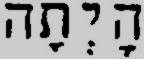 should here
be rendered "was" or "became" since
should here
be rendered "was" or "became" since

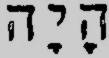 with its
supposed sense of "being", Hebrew would not think it
with its
supposed sense of "being", Hebrew would not think it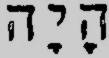 is omitted
in
is omitted
in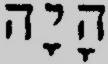 is not pre-
 meaning
"to be headlong" or '"to fall down".
meaning
"to be headlong" or '"to fall down".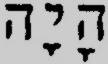 in the
following order: "to fall"; "to come to pass";
in the
following order: "to fall"; "to come to pass";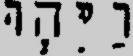 )
both naked and were not ashamed", means not so much that
)
both naked and were not ashamed", means not so much that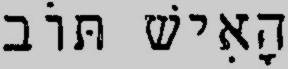 ), and the second,
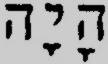
 ).
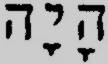
). in this context.
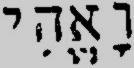
 .
. ) examining ("
 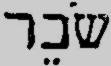 ,
participle) the
,
participle) the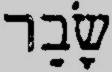 without the associated verb
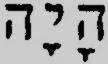 .
But the object seems to be to underscore the idea of continuous
.
But the object seems to be to underscore the idea of continuous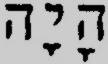 not as "to be" but by some such English word
 ). The whole idea here is one
 )
)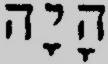 is often used in parallel
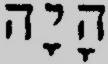 used in the sense of "actively coming into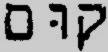
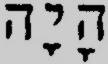 occurs about 3570 times in the Old Testament.
 ) and various verbal
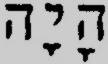 has thus been considered to some extent a general
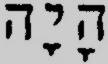 in the Old Testament
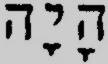 is not used as a copula....
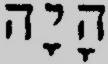 in distinction from our verb 'to be' is that
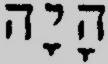 stands alone without any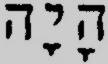
 ), "to
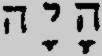 in Gen .1.2
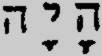 (as we are so frequently assured these days) the general sense
 ). This is quite
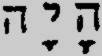 is associated with another
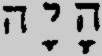 is translated
"became" (or
is translated
"became" (or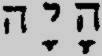 is rendered by some entirely different word that better
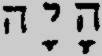 in the original.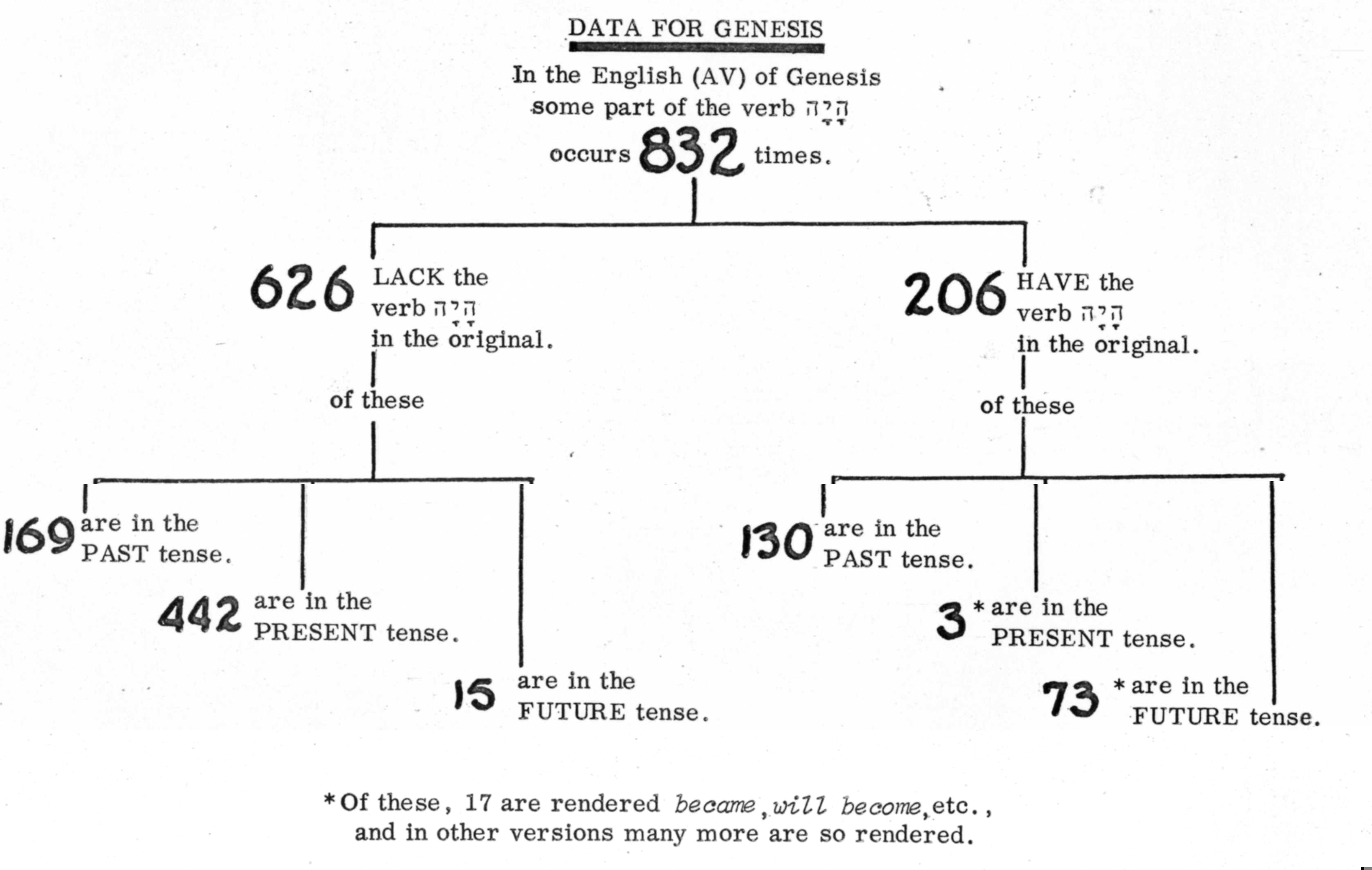
 .
.