|
|


Preface Introduction Chapters Chapter 1 Chapter 2 Chapter 3 Chapter 4 Chapter 5 Chapter 6 Appendices Appendix I Appendix II Appendix III Appendix IV Appendix V Appendix VI Appendix VII Appendix VIII Appendix IX Appendix X Appendix XI Appendix XII Appendix XIII Appendix XIV Appendix XV Appendix XVI Appendix XVII Appendix XVIII Appendix XIX Appendix XX Appendix XXI Indexes References Names Biblical References General Bibliography |
A LONG-HELD VIEW. It is a rare thing
nowadays to find in a scholarly work on Genesis any acknowledgment of the
fact that there is evidence of a discontinuity between the first two
verses of Chapter One and that this was ever recognized by commentators
until modern Geology arose to challenge the Mosaic cosmogony. The usual view is that
when geologists "proved" the earth to be billions of year sold,
conservative biblical students suddenly dis- covered a way of salvaging
the Mosaic account by introducing a gap of unknown duration
between these two verses. This is
supposed to have solved the problem
of time by an expeditious interpretation previously unrecognized.
This convenient little device was attrib- uted by many to Chalmers
of the middle of the last century, and popularized among
"fundamentalists" by Scofield in the first quarter of the present century.
Both the impetus which brought it to general notice and the company it
kept in its heyday combined to make it doubly suspected among
conservative scholars and totally ignored by liberal ones. However, D. F. Payne of
the University of Sheffield, England, in pg
1 of 31 a paper published recently
by Tyndale Press entitled. Genesis One Reconsidered, makes this brief aside
at the appropriate place: "The 'gap' theory itself, as a
matter of exegesis, antedated (my emphasis) the scientific challenge,
but the latter gave it a new impetus". Grant- ed then that the view did
antedate the modern geological challenge, by how long did it do
so? Just how far back can one trace
this now rather unpopular view and
how explicit are the earlier references? And on what grounds was it
held prior to the general acceptance of the views of Laplace,
Hutton, and Lyell? If its
antecedence can be established with any
certainty, one then has to find some other reason than the threat of
Geology for its having arisen. The view was undoubtedly
held by early commentators without any evidence that it was being
presented as an "answer" to some suspected challenge to the veracity
of Scripture. It must therefore have arisen either because a careful
study of the original text of Scripture itself had given intimations of
it, or perhaps due to some ancient tradition about the after-effects of
the catastrophe itself, such after-effects as might well have been
observed by early man before the new order had effectively buried the
evidences of the old. For man
must have been created soon
enough after the event to observe at least some of the evidence which
time has since eroded away. There is evidence of a tremendous and comparatively
recent geological catastrophe still to be
observed even today in certain parts of the world. There are numerous instances of mammoths
and other animals which were by some
agency killed en masse and instantly buried together, the
preyed upon with the predator, while apparently still in the prime of
life. Such animal cemeteries have
frequently been reported in northern
latitudes: in Siberia, for example.
And similar indications may
well have existed in former years in much lower latitudes where
early man could have come across them and pondered their meaning.
Such evidences of destruction, even if it occurred before the
creation of Man, must surely have set men's minds to wondering what
had been the cause. There is no
reason to suppose that early man
was any less observant than his modern descendants, or any less
curious about the cause of such mass des- truction of living forms. At any rate, here in broad
outline is the situation in so far as ancient and modern
literature reflects some knowledge of such an event. This outline will
be explored in detail subsequently - but a summary review may help to
establish the general picture. And it will show that it is
indeed a long-held view. We are in no position at
present to determine precisely how the Jewish
commentators made the discovery, but their early literature (the Midrash for example)
reveals that they had some intimation of an early pre-Adamic
catastrophe affecting the whole earth.
Sim- ilarly, clear evidence
appears in the oldest extant Version of the Hebrew Scriptures (the
Targum of 0nkelos)and some intimation may be seen in the
"punctuation marks" of the Massoretic text of Genesis Chapter One. Early Jewish writers subsequently built
up some abstruse arguments about
God's dealings with Israel on the basis of this belief and it would
seem that Paul in his Epistle to the Corinth- ians is at one point
making indirect reference to this traditional background. A few of the early Church
Fathers accepted this interpretation and based some of their
doctrines upon it. It is true that both they and their Jewish antecedents
used arguments which to us seem at times to have no force whatever,
but this is not the issue. The truth is, as we shall see, that the idea
of a once ordered world having been brought to ruin as a
consequence of divine judgment just prior to the creation of Adam, was
apparently quite widespread. It was
not debated: it was merely held by
some and not by others. Those who held it referred to it and
built up arguments upon it without apparently feeling the need to
apologize for believing as they did, nor for ex- plaining the grounds for
their faith. During succeeding
centuries not a few scholars kept the view alive, and medieval scholars
wrote about it at some length - often using phraseology which gives
their work a remarkably modern ring. The Book of Jasher,
Alcuin's version, seems clearly to assume it - even though the
document itself has a questionable pedigree. It certainly antedates modern Geology
in any case. And for the past two
hundred years many translators and comment- ators have maintained the
view and elaborated upon it at length. In short, it is not
a recent interpretation of the text of Gen. 1.1 and 1.2, but an ancient one
long antedating modern geological views. Indeed - it could be as
old as the writing of Gen. 1.2 itself!
Some of the ancient Sumerian
and Babylonian fragments that, when pieced together, give us a general
view of their cosmogony, seem to lend support to it as a very
ancient belief. It is perfectly true that these epics and legends are full
of fantasy and absurdity if read at their face value - but it is not
absolutely certain that the writers themselves intended them to be taken
precisely at face value. It may have been for teaching purposes. The
use of animation as a mnemonic aid is recognized widely today,
and scientific textbooks for schools and colleges adopt this technique
of teaching without requiring us to believe, for example, that
metallic elements do actually "marry"! Such a simile is employed in
metallurgical literature because it aptly conveys what seems to be
happening when one metal unites with another. The Sumerians and
Babylonians may have animated their cosmogonies for the same
reason, while they themselves actually held much more down-to-earth
views on the matter. We should not assume that their thinking
was altogether childish. At any
rate, there are evidences in
these ancient texts that they looked upon the earth's very early history
as having been one in which things had in some way and at one
particular point in time "gone wrong". And this sense of catastrophe
is not limited to a recollection of the Fall of man. It seems to refer to something prior to
it. It was on a cosmic scale. Since there
are reverberations of these catastrophic events even as far away as
China, it is possible that the earliest writers had knowledge of
things which we now discern only very dimly if at all, and that this
knowledge was generally shared by mankind prior to the dispersion of
Genesis 11. See Appendix XXI. It is surprising that this
almost unbroken thread of testimony to a view that is now widely
held to be of recent origin should have been consistently ignored or
unrecognized for so long. Admittedly it is at times evanescent and occasionally
ambiguous, and admittedly the fanciful methods of
interpreting Scripture adopted by the Jewish Commentators and often
emulated by the early Church Fathers do not exactly encourage one to
seek for solid factual information in their writings, yet at other
times they are quite explicit in their present- ations. At any rate,
whatever use or abuse they may have made of the information they had,
there can really be no doubt that they DID have information of this
sort, and this information seems never to have been entirely lost
sight of from New Testament times to the present. It is worth exploring all
the strands we have, for in one way or another they each tend to
contribute light to the total picture. Yet it must be emphasized once
again, after saying all this, that while it is valuable to be able to
correct a false impression about the antiquity of this view, it really
proves nothing about the correctness or other- wise of the view
espoused. The only way this can be
done is by a study of the text
itself.... which is undertaken in the chapters which follow: the present
objective is a lesser one, a historical sketch. Now after or during the
Babylonian Captivity, the Jewish people gradually accumulated the comments
and explanations of their best known teachers about the
Old Testament for some 1500 years - or well on into the Christian era. This body of traditional teaching was gathered together into the
Midrash which thus became the oldest pre- Christian exposition of
the Old Testament. It was already the basis of rabbinical teaching in
the time of our Lord and must have been quite familiar to Paul. According to the Revised Edition
of Chambers's Encyclopedia published in 1860, under
the heading "Genesis", the view which was then being popularized by
Buckland and others to the effect that an interval of unknown
duration was to be interposed between Gen. 1.1 and 1.2 was already to be
found in the Midrash. In his great work, The Legends of the Jews, Louis Ginsberg has put
into continuous narrative a precis of
their legends, as far as possible in the original phrase sand terms. In Volume
1 which covers the period from the Creation to Jacob, he has
this excerpt on Genesis 1: "Nor is this world
inhabited by man the first of things earthly created by
God. He made several other worlds before ours, but He
destroyed them all, because He was pleased with none until He
created ours." Clearly this reflects the
tradition under lying the translation which appears in the Targum of
Onkelos to be noted below. Furthermore, in the
Massoretic Text in which the Jewish scholars tried to incorporate enough
"indicators" to guide the reader as to correct punctuation there
is one small mark which is technically known as Rebhia
which is classified as a "disjunctive accent" in- tended to notify the
reader that he should pause before proceeding to the next verse. In short,
this mark indicates a "break" in the text. Such a mark appears at the
end of Genesis 1.1. This mark has
been noted by several scholars
including Luther. It is one
indication among others, that the
initial waw ( should be rendered
"but" rather than "and", a dis-junctive rather than a con-junctive. Another piece of
substantiating evidence is to be found in the Targum of Onkelos, the earliest
of the Aramaic Versions of the Old Testament written by
Hebrew Scholars. According to the Babylonian Talmud, Onkelos was a
proselyte, the son of a man named Calonicas, and although he was
the composer of the Targum which bears his name, he is held actually
to have received it from Rabbi Eliezer and Rabbi Yehoshua, both of
whom lived towards the end of the first and the beginning of the
second century A.D. However, since
in the Jerusalem Talmud the very
same thing is related by the same auth- orities (and almost in the
same words) of the proselyte Aquila of
Pontes, whose Greek version of the Bible was used by the Greek- speaking Jews down to the
time of Justinian, it is sometimes argued that Onkelos is but another
name for Aquila. Aquila Ponticus was a relative of the Emperor
Hadrian, living in the second century B.C. Thus even if Onkelos is
not yet completely identified, the Targum attributed to him must
still be placed early in the second century B .C. As his translation into
Aramaic of Gen.1.2, Onkelos has the following: In this passage, the
verb verb which itself means
"to cut" or "to lay waste". We have here, therefore, a rendering
"and the earth was laid waste", an interpret- ation of the original
Hebrew of Gen. 1.2 which leaves little room for doubt that Onkelos
understood this to mean that something had occurr- ed between verse 1 and
verse 2 to reduce the earth to this desolated condition, It reflects
Ginsberg's Jewish legend. Akiba ben Joseph was an
influential Jewish rabbi who was president of the School Bene Barek
near Saffa. He laid the basis for
the Mishna. When Barcochebas rebelled against the
Romans, Akiba joined him and was
captured. He was executed in 135 A.D.
The ancient work known as The
Book of Light or Sefer Hazzohar,
some- times simply Zohar was
traditionally ascribed to one of Akiba's disciples, a certain
Simeon ben Jochai. In this work,
which thus represents an opinion held
towards the end of the first century and the early part of the
second, there is a comment on Gen. 2.4-6 which, though difficult to
follow, reads thus: "These are the
generations (ie., this is the history of....) of heaven and earth....
Now wherever there is written the word 'these' ( And these are the
generations of the destruction which is signified in verse 2 of
chapter 1. The earth was Tohu and Bohu. These indeed are the
worlds of which it is said that the blessed God created
them and destroyed them, and, on that account, the earth was desolate
and empty." Here, then, we have a
comment which in the time of our Lord was held widely enough
that Paul might very well have known about it. In which case we may better understand the
background of his words in writing to the Corinthians
(II Cor. 4.6) where he said, "God
Who commanded the light to
shine out of darkness hath shined into our hearts, to give the
light of the knowledge of the glory of God in the face of Christ Jesus". Now very few will deny
that in this passage Paul is referring back to Gen. 1.3, "And God
said, Let there be light". What
is not ab- solutely certain is how
far one can press the analogy. Personally, I believe it makes excellent
sense to assume here that Paul had in mind an interpretation of these
first three verses of Genesis 1 which sees the situation as a ruin
about to be restored by God's creative power, commencing with the giving
of light where all was formerly darkness. This is , after
all, precisely the position that the unredeemed soul is in. The analogy is most
pointed and reasonable. And if we once allow that this is what
was in Paul's mind, then we must surely also admit that Paul, speaking
by inspiration, set his seal upon the truth of the interpretation of
Gen. 1.2 for which we are here contending; and the more ancient
tradition which lies behind the words of Akiba and the rendering of
Onkelos receive a measure of confirmation. In his Rabbinical
Commentary on Genesis, Paul Isaac Hershon has this somewhat obscure
quotation which reinforces Paul's analogy: '"And the earth was
desolate and void'. The earth will be desolate, for the
shekinah will depart at the destruction of the Temple, and hence it
is said: 'And the Spirit of God hovered upon the face of
the water'; which intimates to us that even although we be
in exile (after the destruction of the Temple) yet the Torah
shall not depart from us; and there- fore it is added: 'And God
said. Let there be light'. This shows us that after the
captivity God will again enlighten us, and send us the
Messiah....". Admittedly, this mode of
interpretation is strange to us, but there is really no doubt what is
intended. The Promised Land with its capital city epitomized by
the Temple, was once the place of God's Shekinah glory. But now it
has been destroyed and made empty, as Jer.4.24 f. predicted.
Nevertheless, it was not destroyed perm- anently , for the Spirit of
God still hovers over the place of His former 'glory', though for the
present it is destroyed and made empty. In due time, just as God's
Spirit hovered over the destroyed earth with a promise of new life to
come upon it, so will He restore the Land and the Temple and renew
His glory by the presence of His Messiah Who shall come. There is little question
that the whole hope of restoration under-
lying this passage from
the rabbinical commentary is based on a view of Genesis which sees in
verse 3 a similar case of restoration after judgment. And the belief
that this restorative process began in the first case with a command that
the light shine out of the darkness, and that this will again occur
when a new Light shines unto Israel is surely the Jewish background of
Paul's words to the Christian believers in Corinth. I believe, moreover, that
there may be one further evidence in the New Testament of this
view in (appropriately) the Epistle to the Hebrews. Here in Heb.11.3 the writer makes this
significant observation: "Through
faith we understand that the worlds were framed by the word of
God". The significant thing about this state- ment in the present
context is that the word rendered 'framed' is the Greek verb katartidzo
( perfect' in seven cases in
the New Testament (Matt. 21.16; Lu. 6.40; I Cor. 1.10; II Cor.
l3.11; I Thess. 3.10; Heb. 13.21; and I Pet. 5.10), is more strictly a word
meaning 'to repair' or 'to restore'.
In Matt. 4.21 and Mark 1.19
it is used of repairing or mending nets. Liddell and Scott give the
meaning in Classical Greek as 'adjust', or 'put in order again', or
'restore'. Even Young in his Concordance at these references
(above) where the word is rendered 'to perfect' adds that its meaning is
'to fit thoroughly' or 'to adjust'.
And in Classical Greek the word
was used by Herodotus (5.106) to mean 'to put in order again',
and (5.28) 'to settle by acting as mediator', and so 'to reform'; while
Polybius uses it of repairing a ship, or setting a broken bone. Thayer
says of its use in I Pet. 5.10 that it has the meaning of 'making
one what he ought to be'. This could, of course, mean nothing more
than the 'maturing' of the individual with no necessary implication
of a process of mending his ways. How- ever, Thayer also adds at
the same place, as an illustration of its use in an ethical sense.
Gal. 6.1 where it is used 'of those who have been restored to harmony'.
So that we understand by faith how the worlds were restored
and made fit for man by the Word of God. Now, any one of these
pointers taken alone might carry little weight. But put together they seem to require
that we recognize the real possibility that
a view of Gen. 1.1 and 1.2 which many today feel strained and improbable
may in fact have been generally taken for granted in our Lord's
day and during the first century or so of the present era. In no case
does the view seem to have been 'defended', and this could be either because
it was so widely accepted - or because it did not seem to have
any great significance. There are
many today who feel that this
catastrophic event was a significant turning
point in the thread of
God's self-revelation and that this is reflected in the recurrent New
Testament phrase "since the foundation of the world", a phrase
which they believe should rather be rendered "since the disruption of
the world". I also, at one time, felt well satisfied that this is a more correct
translation, but I have come to feel that the grounds for it are not
altogether satisfactory from the linguistic point of view. Since a
good argument is not strengthened by a weak link, I have not appealed to
this possibility as part of the 'evidence’, but careful consideration
of some of the pros and cons will be found in Appendix XIX. In any case, the view was
never thereafter entirely lost, even though it was sometimes
presented only in the form of an opinion that such a gap did exist, a
time interval of unknown duration between the initial creation and the
work of the six days which began in verse 3. Origen, for example, who
lived from 186 to about 254 A.D., and to whom the original
languages of the Bible were very familiar, has this to say in his great
work, De Principiis, at Gen. 1.1: "It is certain that
the present firmament is not spoken of in this verse, nor the
present dry land, but rather that heaven and earth from which this
present heaven and earth that we now see afterwards
borrowed their names." And that he saw verse 2 as
a description of a "casting down" of the original is borne out
quite clearly by his subsequent observation that the condition resulted
from a "disruption" which is best described, he suggests, by the Latin
verb dejicere, ‘to throw down’. In the course of time,
attempts were made - not unnaturally - to fill in the details of the
event which led up to the devastation described. Since all such effects
were presumed to be moral judgments and since man had not yet been
created, the angels were blamed. Somewhere around 650 A.D. , the
English poet Caedmon (who died about 680) wrote about Genesis and
the creation, and presented the view that man had really been
introduced in order to replace the angels which had conducted their
dominion over the earth so ruinously.
Fallen angels were responsible
for the catastrophe. Whether the
poems attributed to Caedmon were
really his is a moot point, but someone in the seventh century
knew about this tradition. According to Bede, these poems we re supposed
to have resulted from a dream in which an angel told Caedmon to sing
and write about the Creation. This he finally did, though at
first reluctantly, producing works dealing with the creation of the
world, the origin of man, and the whole history
of Genesis. All the 'poems' or songs thus attributed
to Caedmon were first published by
Francis Junius in 1665 from a manuscript now in the Bodleian
Library, Oxford. At present of the whole series on Genesis, Exodus,
Daniel, and Christ and Satan, it is generally conceded that only the one
on Genesis is really Caedmon's work, and even this has perhaps been
transmitted to us in an interpolated and modified form. At any
rate, the basic idea regarding the destruction of the old world seems to have
been known to him, and subsequent modifications of his
original text do not alter the fact that in Bede's time (674 - 735 A.D.) this
view was known and discussed whether by Caedmon him self or by
those who took it upon themselves to modify his works. The earliest manuscript we now have is of
the 10th century and it gives no
indication (by signature) of its authorship, but the substance of it agrees
well with what is attributed to Caedmon. This work, which is a
commentary on the first 22 chapters of Genesis with one small
missing segment near the beginning, was written in verse but is
rendered as prose by Mason in his translation. Caedmon is not as specific
as one would wish but his view in brief is that the created order
which preceded the present heaven (and earth ?) system was ruled over by
Angels. In his own words: "These angelic hosts
were wont to feel joy and rapture, transcendent bliss in the
presence of their creator; then their beautitude was
measureless. Glorious ministers magnified their Lord, spoke his
praise with zeal, lauded the Master of their being, and were
excellently happy in the majesty of God. They had no knowledge of
working evil or wickedness, but dwelt in innocence forever
with their Lord; from the beginning they wrought in heaven
nothing but righteousness and truth, until a Prince of Angels
through pride strayed into sin: then they would consult their
own advantage no longer, but turned away from God's loving
kindness. "They had vast
arrogance in that by the might of their multitudes they sought to
wrest from the Lord the celestial mansions. Then there fell
upon them, grievously, the envy, presumption, and pride of
the Angel who first began to carry out the evil plot, to
weave it and promote it, when he boasted byword - as he thirsted
for conflict - that he wished to own the home and high throne
of the heavenly kingdom of the north". So the Lord cast them
"that had committed a dire sin" (line 46) into a specially created
"joyless house of punishment", banishing
them from heaven (line
68). "Then, as formerly, true peace existed (once more) in heaven,
fair amity: for the Lord was dear to all, the Sovereign to his
servants" (line 79 and 80). But
the 'heavenly seats' of these rebellious
creatures were now vacant. So (line 92 f.): "Our Lord bethought
him, in meditative mood how he might again people, with a
better race, his high creation, the noble seats and glory crowned abodes
which the haughty rebels had left vacant high in
heaven. Therefore Holy God willed by his plenteous power that under
the circle of the firmament of the earth should be
established with sky above and wide water, a world-creation (ie., as
opposed to a heavenly one) in a place of the foes whom in their
apostasy he hurled from bliss". The poet then describes
how "this broad earth stood.... idle and useless, alien even to God
himself" (line 105) until God looked upon it in its joylessness and darkness,
and then "created heaven and earth" (line 114). It is thus not
too easy to see how he views these events in their precise temporal
relationship, for he first describes how this "broad
earth" existed in its uselessness and then some ten lines later he describes God's
remedial action in creating not merely heaven but earth also.
Perhaps he really means creating order on the earth rather than
actually creating the globe itself. At any rate, there existed
an order of created beings prior to all this who, though living in
heaven, had failed to fulfill their appointed role in the economy of
God. And then there existed an earth
in shrouded darkness and in a
chaotic state which God later turned into a habitation for an order
of created beings destined to replace the fallen angels. Admittedly
not a very clear account, but at least one which makes it apparent
that a created order existed long before Day One of the Creation
Week. The purpose of the
ordering of this alienated world was to provide a home for this new race.
But whether the earth's "state of alien- ation" from God (as
Caedmon evidently views Gen. 1.1 and 2) was in any way the direct
consequence of the fall of the Angels, he does not make clear. Perhaps he thought it was obvious. According to Erich Sauer,
King Edgar of England (943-975) adopted the same view.
This man was an unusually gifted individual and it was largely due to
his enthusiastic co-operation with Dunstan, the then Archbishop of Canterbury,
that Monasticism was revived in England. The evils which in time arose from these
institutions should not allow us to
overlook the fact that in an age which was indeed
dark they kept alive and
carried over from antiquity the learning and lore which in due time
became the starting point for the Renaissance. It was certainly in part
due to the learning which this king himself evidently enjoyed that
royal patronage was so gladly given to the revival of the only schools
known to that age. I have no precise information on what he
actually said on the present issue, but evident- ly his opinion was shared
quite widely by his contemporaries. Hugo St. Victor
(1097-1141) was a Flemish scholar and a member of the Augustinian
Monastery of St. Victor and later Prior of the monastery in Paris. He wrote: "Fortassis jam satis
est de his hactenus dis- putasse, si hoc solum
adjecerimus quanto tempore mundus in hac confusione,
priusquam ejus dispositio inchoaretur,
perstiterit. Nam quod illa priam rerum omnum materia, in
principio tempros vel potius cum ipso tempore exorta
sit, constat ex eo quod dictum est: in principio creavit Deus coelum et
terram. Quandiu autem in hac
informitate sine confusione permanserit, scriptura
manifeste non ostendit." ie. "Perhaps enough has already been
debated about these matters thus far, if we
add only this, 'how long did the world remain in this disorder
before the regular re-ordering (dis- positio) of it was taken
in hand? For the fact that the first substance of all things
arose at the very beginning of time - or rather, with time itself -
is settled by the statement that, 'In the beginning God created
the heavens and the earth'. But how long it continued in
this state of confusion. Scripture does not clearly show". In this remark Hugo is
certainly not saying, specifically, that he sees the disordered state
of the world in Gen. 1.2 as the result of a catastrophe of some kind. He
could mean merely that it began this way and, as here
visualized, was only awaiting the ordering hand of God to make it into a
Cosmos. What is, I think, quite clear is that he did not equate the work
of the first day with the act of creation. A period of time of
unknown duration intervened between Gen. 1.1 and 1.2. This is all he
intends: but it is this admission which we wish to underscore. Two centuries later,
Thomas Aquinas (1226 -1274) reiterated this view when he wrote:
Sed melior videtur dicendum quod creatio fueritaute omnen diem... ie. "but it seems better to maintain
(the view) that the creat- ion was prior to any of
the days (literally, before any day)." St. Thomas evidently
considered that the first day was not to be equated with the time of
creation itself. This first day came later: he does not suggest how
much later. In somewhat indefinite
statements like this, only one thing stands out clearly. The writers would not have agreed with
Ussher that Creation occurred 4000
B.C. They might very probably have assented to his chronology
as applied to the creation of Adam but they would have set the
creation of the Universe (the heavens and the earth) further back in
time by some unstated amount. Gen. 1.2 does NOT represent the
condition of things immediately after the initial creation.... but some time
later. None of these writers ventured to suggest just how long
the interval had been. The idea of an earth so old that the period of
man's history pales into insignificance when viewed merely in
chronological terms was probably not in their thoughts. One has the
impression rather that they saw this interval merely as an interval....
not as a period perhaps vastly greater than all the time that has
elapsed since. My point here is
merely to emphasize that we cannot
make any more of these witnesses than to say that they did believe
there was a break in the creative processes between Gen .1.1 and 1.2.
They may have seen it as of quite a short duration. At any rate, it is clear
that the creative process did not proceed smoothly and unbrokenly from
Gen. 1.1 to Adam. With the passage of time, the question of a
discontinuity became crystallized more concretely and was
discussed in greater detail. Thus
Dionysius Petaviua (1583-1652), A
French Roman Catholic Jesuit Theologian who was first Professor of
Philosophy at Bourges and later Professor of Theology at Paris,
wrote: "Quod intervallum quantum fuerit, nulla divinatioposset assequi. Neque vero mundi corpora illa, quae prima omnium
extitisse docui, aquam et terram, arbitror eodem, in quem
lucis ortus incidit fabricata esse die; ut quibusdam
placet, haud satis firma ratione." ie., "The question
of 'How great an interval there was ', it is not possible except by
inspiration to attain knowledge of. Nor, indeed, do I judge
those basic components of earth and water, which I have taught
originated first of all, to have been fabricated the same day on
which had occurred the appearance of day light, as it
pleases certain persons (to believe), but by no means with sound enough
reason." That is to say, Petavius
did not agree with some who asserted, without sufficient reason,
that the basic elements out of which land and water were later made
came into being on the same day that the land and water themselves actually
did. These basic elements were made long before the
actual creation of water and land, though no man can know how long ago
apart from revelation, and that revelation is not to be found in
Scripture. And even more specific was
the most learned of all medieval commentator son Genesis,
Pererius (1535 - 1610) who wrote: "Licet ante primum diem, coelum et elementafacta sint secundum
substantiam, tamen non fuerit perfecta et omnino
consummata, nisi spatio ittorum sex dierum: tunc enim datus est illis omatus, comptementum, et
perfectio. Quanto autem tempore status ille mundi
tenebrosus duraverit, hoc est, utrum plus an minus quam
unus dies continere solet, nec mihi compertum est,
nec opinor cuiquam mortalium nisi cui divinitus id esse
patefactum.” ie. , "Even though
before the first day, the heavens and the elements were made
subsequent to the substance (ie. , basic essence of creative
activity) nevertheless they were not per- fected and completely
furnished until the period of the six days: for then was given
to them (their) furnishing, (their) fulfillment (filling up),
and (their) completion. However, just how long that
darkened state of the world lasted, ie., whether it lasted more than
one day or less than one day, this is not clear to me, nor (I
hold) is it clear to any other mortal man unless to one to whom
it has been divinely made so." This statement, suffering
as it does to modern eyes from the complexity of sentence structure
characteristic of the age in which it was written,
nevertheless once more confirms the view stated by others quoted above that
before the six days began and after the initial substance of the world had been created, an interval of time of unknown duration
intervened-during which the world was in a dark- ened state. It would appear that by this time the
view of such a darkened world as being
also a destroyed world was beginning to be lost sight of, the poet
Caedmon being the last writer, as far as I have been able to discover, who
viewed the situation in the light of a divine judgment upon a previously
ordered system. Yet this concept was not entirely lost, for in due
time we begin to meet it once again in more and more specific terms,
especially by Roman Catholic scholars on the Continent. According to Bernard Ramm,
the subject received its first scient- ific treatment by J. G.
Rosenmuller (1736- 1815) in his Antiquissima Tellures Historica published in 1776, a
treatise which formed the basis of the theological
works of Bohme. At any rate, it seems to have been sufficiently
broadly recognized to influence Alcuin in his edition of The Book of
Jasher which although it may very well be a forgery was at least
issued somewhere towards the end of the 18th century. Alcuin renders the counterpart of Gen.
1.2 (which in his version appears, however,
as verse 5) as follows: "So that the face of nature was formed a
second time". From 1763 to
1781, the Orientals Scholar and
Biblical Critic, Professor Johann August Dathe of Leipzig published his
great six-volume work on the Books of the Old Testament and he
translated Gen. 1.2; "Afterwards the earth became (facta erat)
a waste and a desolation". He
comments on this passage as follows: "Vau ante
|


 ) which
introduces verse 2
) which
introduces verse 2
 is compounded with the Aramaic
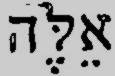 ) the
previous words are put aside.
) the
previous words are put aside. ) which although it is rendered 'to
 non potest
verti per ET, nam
non potest
verti per ET, nam ) before 'the earth' cannot be translated 'AND',
 should be
 ) in Hebrew
 in Aramaic)
meaning "to be desolate", "confounded",
in Aramaic)
meaning "to be desolate", "confounded",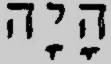 lay at the root of it but that it does not
 ('to be') but
  ('to become')!
 reinforces the idea of judgment.
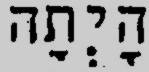 ('was') is more than
 ,
a des-
,
a des-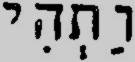 must have stood in the place of
 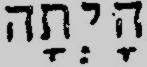 ."
." omitting the verb - just as it is
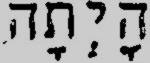 has no force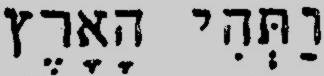
 and joined
 being in the past tense, relates to
 .
No
.
No expresses time
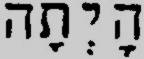 .
.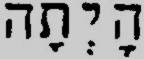 ,
just as the verb is omitted in the words
,
just as the verb is omitted in the words .
.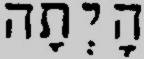 denotes time, and if so, then
 is used, which there is no occasion to be so
 is introduced by
 of verse 1.
 in the Septuagint, see App-
|
Home | Biography | The Books | Search | Order Books | Contact Us |