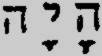
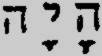
|
|


Preface Introduction ChaptersChapter 1 Chapter 2 Chapter 3 Chapter 4 Chapter 5 Chapter 6 AppendicesAppendix I Appendix II Appendix III Appendix IV Appendix V Appendix VI Appendix VII Appendix VIII Appendix IX Appendix X Appendix XI Appendix XII Appendix XIII Appendix XIV Appendix XV Appendix XVI Appendix XVII Appendix XVIII Appendix XIX Appendix XX Appendix XXI IndexesReferences Names Biblical References General Bibliography |
THE PLUPERFECT IN HEBREW. To my knowledge, there is no work in the English language dealing specifically with the
Hebrew verb comparable to that published in 1892 by S. R. Driver
entitled, A Treatise on the Hebrew Tenses. The expanded title as it
appears on the first page is, "A Treatise on the Use of the Tenses in
Hebrew and some Other Syntactical Quest- ions". As might be
expected from a man with Driver's scholarship, the treatment of tenses is
thorough and precise, and massively illustrated with
innumerable examples taken from Scripture. In the present Chapter,
our primary concern is with the use of the pluperfect in Hebrew
and we shall not here enter into detailed consideration of the other
tenses, of such questions as the "waw consecutive", the
mode of expressing continuing present action, or action in the future. Nor will the philosophy of the Hebrew
time- sense be examined in any
depth, remarkable as it is, in spite of the fact that much of Driver's
treatise deals with this aspect of the subject. All these are of
importance for the student of Hebrew, of course, but they are
explored here only to the extent that they con- tribute to an
understanding of the Hebrew use of the pluperfect. pg
1 of 14 Suffice it to say that the formal paradigm of the Hebrew verb presents us with a perfect
tense for describing completed action, and an imperfect tense for
describing incomplete action: and these two tenses are by various
means made to serve all the other tenses, pluperfect, present, and
future. For example, the verb qatal ( is killing": and it
appears in an appropriate form "he is killed". The verb also has the passive
form, "he is being killed" and "he was killed": and of
course there are the usual participles, imperatives, infinitives, etc., both
active and passive. Unlike English,
the verb has a specific form
for the reflexive (which would mean "to kill oneself, ie. , to commit
suicide), as well as an intensive form "to kill with violence"
(ie. , to slaughter), and a causative form, "to have someone put to
death". Thus in the matter of
conjugations the Hebrew verb is well enough
supplied but in the matter of tense, that is to say of time, Of it
is limited to two forms only. Clearly a single tense
form has therefore to serve a much wider range of meanings than in
English. Shades of difference about the timing in the past or the
future do not seem to have been considered sufficiently important to
justify special forms for either a pluperfect or a future tense. With
respect to the latter, it has been suggested that, like other
non-Indo-Europeans, they held the view that to speak of something which is to
occur in the future is unrealistic since one cannot really be sure
about it. Thus no specific verbal
form was ever "invented"
to cover it. It can be a promise or an intention, but as far as man is concerned
it hardly constitutes a fact! With God, of course, it is quite different.
When He says. He will do something in the future, it IS a
fact, and the certainty that it will be done led the Hebrew writer to use a
perfect tense as if it were already a fait accomplis. Most divinely originated promises are
treated thus, and the verb is
written in a form which is referred to by gram- marians as the
"prophetic perfect". Brief mention must be made
of one odd feature of Hebrew syntax that has puzzled
Indo-European readers since it seems an irrational procedure. It is this. When a sentence or a clause begins with the conjunction
"and" (waw), the verb which immediately follows it and to which it is joined
as a prefix, has its tense converted!
A perfect is treated as an
imperfect and an imperfect as a perfect. Thus the form for the
English, "he is killed", if it happens to have the waw prefixed to
it, is converted as though it were no longer a perfect and completed
action but an imperfect and uncompleted action. "He killed"
becomes "and he is killing" or "and he kills" or even
"and
he will kill": ie., any one of the uncompleted modes of expression. This is sometimes referred
to by Hebrew scholars as the waw- conversive" (ie. ,
waw which converts) and sometimes as the waw - consecutive" (ie.,
verb following or consequent to what precedes). We shall not have occasion
to revert to this very much in the present study except in quoting
Driver to show what it can NOT be made to mean. Now evidently Hebrew writers
did feel it desirable to have some means of distinguishing
between the implications of a perfect and a pluperfect tense. If there is only one verbal form to cover
both ideas, one necessarily has
to adopt some "device" other than changing the verbal form. To convey the idea of a pluperfect as
distinct from a perfect, Hebrew
writers adopted the practice of deliberately changing the normal word
order of the sentence. It is this
with which we are primarily
concerned in the present chapter. The normal English sentence, in its simplest form, places the subject first, the verb
next, and the object after the verb. In Latin the verb is placed at or
near the end of the sentence, after both subject and object. In Hebrew the normal order is verb first,
subject next, and object after
that. Thus the order is: In English: "The king
appointed his ministers...." In Latin: "The king
his ministers did appoint...." In Hebrew: "He
appointed, did the king, his ministers..." English, of course, allows changes or departures from the normal in the interests of
emphasis, contrast, euphemy, and by poetic licence. Hebrew is remarkably consistent and
departs from the norm with rather less
frequency than does the English, though it makes similar allowances
in poetry and adopts rather similar rules for emphasis or
contrast. In the latter case, it is
customary to place the subject ahead of
the verb in order to emphasize a change. "The king planned
this but God determined otherwise" would be a situation in which the
Hebrew writer would place the second subject, "God", ahead of
its verb, the conjunction being read more approp- riately as a disjunction
than a conjunction in such a case. However even in this kind of situation
the Hebrew would not always change the word order. It really depends upon how great the contrast is felt to be and whether it is
desired to draw special attention to it or not. The reason for emphasizing
this point is that the change of word order in the sentence, ie., the
placing of the subject ahead of the verb in- stead of the reverse, is a
device which happens also to serve the purpose of converting a
perfect into a pluperfect. Thus when the word order IS changed one has to determine for which cause this has been done, although in
some cases it may have been done for both reasons. The use of a pluperfect in a narrative has a special importance because it frequently
indicates a hiatus. When the second sentence is not immediately
connected with the one which precedes it, when the narrator is reverting
to an event or a circumstance that in point of time is to be placed ahead
of and distinct from the events recorded in the subsequent
narrative, then it is customary to place the subject ahead of the verb and it
is proper to render the verb as a pluperfect. It is not the verb form
which is changed but the word order; and since there is disconnection or
discontinuity intended by this device, it is usual to preface the
sentence with waw-disjunctive rather than waw- conjunctive, which in an
English translation would mean replacing the "and" with
"but" or "however" or "meanwhile". For example, in such a sentence as,
"The king came to the valley but the enemy had fled", the Hebrew
would place the subject "enemy" ahead of the verb "fled",
thus converting it to a pluperfect "had fled". In a sentence of this kind, we have a situation in which both contrast and discontinuity appear
in a single context. There is
contrast because, while the king
planned one course of action confidently looking for an engagement,
the enemy had planned otherwise and had already left in order to
avoid one! The situation is such
that the departure of the enemy was
already completed before the king arrived on the scene – and
therefore the context calls for a pluperfect in the translation. The conjunction (waw) would properly
be rendered a disjunctive
"but" or "however" or some such word, and whether we look upon the inverted order as signifying contrast or discontinuity matters little, for both
views are equally correct. The context will usually settle the matter in
any case. In such a sentence as
"The king planned this but the
people planned otherwise", the inverted order would be used to
signify contrast primarily, but even here a pluperfect might not be
inappropriate: "but the people had planned otherwise". Thus, in
the present issue, the word order of Gen. 1.2 virtually demands a
pluperfect if it is once allowed that the verb cannot be taken as a
simple copula. "But the earth had become...." is almost certainly the more
appropriate rendering. Now Driver writes at some
length on this point. In discussing the usual idiom chosen by
Hebrew writers for the purpose of express- ing a pluperfect, he says:
"Their custom, when they wish to do this is to interpose the subject
between the conjunction and the verb He then draws attention to Pusey's comments on the same subject and advises the reader to
refer to the well-known Lectures on Daniel where Pusey write sat some
length on the inverted word order which he says, "expresses
a past time, anterior to what follows but in no way connected in
time with what precedes". Driver then gives the
following series of illustrations from the Old Testament and comments
upon each as indicated. I have not quoted his comments
directly because his style is such as to demand that one has read the text
which preceded. I have merely summar- ized his words. But I have done so without in any way
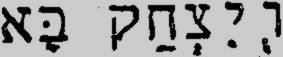
changing his intended meaning. Gen. 24.62: "Now,
Isaac had come from the way of the well La- hairoi; for he dwelt in
the south country. And Isaac went
out to meditate in the field at
the eventide: and he lifted up his eyes and saw, and, behold, the camels
were coming. And Rebekah lifted up her eyes, and when she saw
Isaac, she lighted off the camel.....". The opening verb is to be
read as a pluperfect, for here the writer wishes to combine two
streams in his narrative; ie., he has (i) brought Rebekah to the termination
of her journey, but (ii) he also desires to account for Isaac's presence at the same spot. In order to prepare the way for their meeting,
he is obliged to go back and to detail what had taken place prior to
the stage at which his narrative has arrived: he therefore starts afresh
with the words ject (Isaac) + the verb,
in this order). The whole of verse 62 f. bears reference to Isaac
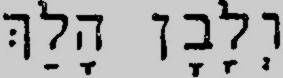
and the two streams which are terminated respectively by in verse 64 which says, "And she lifted up, did Rebekah, her eyes" ( So also in Gen. 31.19:
( shear his sheep, when Rachel stole the images that were her father's". That is to say, the
possibility of Rachel stealing the images was a direct consequence of the
fact that Laban had gone away. To a reader who is unfamiliar
with Hebrew, these illustrations may be difficult to follow
precisely, but Driver chose these examples, among others, simply
because they do exactly illustrate the point he is making: namely, that
the first clause is so constructed in the Hebrew as to convey a
pluperfect sense whereas the second clause is not, and this construction
is dependent entirely upon the interposition of the subject between the
conjunction and the verb. Driver then clarifies the issue somewhat by providing the reader with a number of biblical
illustrations for which he gives the reference and a key word or two. I
have set forth these references much more fully because probably not
too many readers will take the time actually to look them up - and the force
of his observations will thus largely
be lost. I have added a note, where appropriate,
relative to the Revised Standard Version
renderings. Here is his list. Gen.20.4: But Abimelech had not (actually) come near her.. ..." The situation here is that
Abraham, for fear of being put to death by Abimelech whom he
suspected would want to take his beautiful wife Sarah, had posed as her
brother instead of her husband. According- ly, Abimelech had treated
the supposed brother with extreme favour, and then taken Sarah off
to his palace.... But, as it happens, he had a dream that came to warn
him against his intended action and this dream occurred
providentially before the King "had come near her". Hence the writer wishes
the reader to know, since the narrative is written in retrospect,
that Abimelech meanwhile had not yet actually abused Sarah - and so, as
things turned out, had done her no harm. It will be noted that both
the Authorized Version and the Revised Standard Version have
translated the Hebrew as a pluperfect. I Sam. 14.27: "Jonathan had not heard" that his father had given the order forbidding the
eating of a certain honeycomb. So Jonathan disobeyed an order of whose
existence he was ignorant. It will be noted in this instance
that the Authorized Version does not observe the tense indicated by the
Hebrew word order, whereas the Revised Standard Version has done
so. It should be underscored that in all these, as well as in the
following cases, the noun precedes the verb. Num. 13.22: "Now
Hebron had been built seven years before Zoan in Egypt". The very
sense of the narrative here would, one might suppose, guide the
translators - even if the Hebrew text did not provide the clue. Nevertheless, for some reason neither
the Authorized Version nor the
Revised Standard Version translated this passage correctly. This
fact should be sufficient indication, as we shall have reason to underscore
later, that it is not enough in such matters to appeal to two
such standard translations and merely depend upon how they dealt
with the matter. Driver is right: this is quite clear from the very nature
of the context. The Revised
Standard Version scholars were not
sufficiently careful - and the Authorized Version scholars may not
even have been aware of the rule.
Both mistranslated the text. Josh. 6.22: "But
Joshua had said unto the two men...." Josh. 18.1: ".... and
the land had (already) been subdued before them". In Josh. 6.22
the Authorized Version observed the rule, the Revised Standard Version
did not. In Josh. 18.1 neither the Auth- orized Version nor the
Revised Standard Version observed it. I Sam. 9.15: "Now,
the evening before Samuel came, the Lord had told Samuel...." The Authorized Version and the Revised
I Sam. 25.21: "Now
David had said..." So
the Authorized Version and the Revised
Standard Version. I Sam. 28.3: "Saul had
put away all that had familiar spirits". Both the Revised Standard
Version and the Authorized Version obser- ved the pluperfect here. II Sam. 18.18: "Now
Absalom, in his lifetime, had taken and reared up a pillar unto himself...." Both versions agree. I Ki. 14.5: "Now the
Lord had said unto Abijah...."
Here neither the Authorized
Version nor the Revised Standard Version (nor the Berkeley translation, I
notice) have observed the correct sense. I Ki.22.31: "But the king of Syria had commanded his
thirty cap- tains....". The Revised Standard Version agrees, but
not the Authorized Version. II Ki. 7.17;
"Meanwhile the king had appointed the lord, on whose hand he leaned, to have
charge of the gate...." This circumstance was fatal to the king,
hence it is a piece of information cast in retro- spect by way of preparing
the reader for what followed. The Revised Standard Version noted the
word order, but the Authorized Version did not. II Ki. 9.16: "Meanwhile,
Ahaziah, King of Judah, had come down to see Joram...." Again, the Revised Standard Version
agrees with, but the Authorized
Version has not observed, the rule. It will be noted that in
all these instances the sentence is best introduced by the disjunctive
particle in order to underscore the fact that there is no immediate
connection with what precedes. Driver sometimes has
"and" where I have substituted "but" or "now"
or "meanwhile". The
point needs no defending for the Hebrew waw ( which stands at the
beginning of each of these references has an almost unlimited number of
meanings,* so that one may adopt the meaning most suitable to the sense
without doing any injustice to the Hebrew original. After concluding this list
of illustrations, Driver adds that in each of these passages, by
separating the verb from the conjunction and in- terposing the subject
between the two, "the writer cuts the connex- ion with the immediately
preceding narrative, and so suggests a plu- perfect" (his
emphasis). This is a most
significant comment when applied to Gen. 1.1
and 1.2. * See Appendix XIV.
In A
Resurvey of Hebrew Tenses, Frank R. Blake gives, as one of the variant meanings of
the "perfect" tense form in Hebrew, "a past perfect (ie.,
pluperfect)" denoting something more than merely a completed situation and
"occurring normally only in multiple sent- ences". As an example, he refers to Gen.
31.33-34. It will be noted that the
pluperfect element of the sentence, "but Rachel had taken....",
describes a past act which is pictured as having occurred before Laban
came to Rachel's tent. By analogy,
we should assume, therefore,
that the pluperfect is used to describe something which occurred
prior to the events which thereafter form the main thread of the
story. It describes a circumstance ancillary to the rest of the
narrative. Accordingly, it seems
likely that Gen. 1.2 is ancillary in
the same sense to what follows in Gen. 1.3ff. We come now to an example,
given by Driver, of a special kind. He points out that in the
normal course of events, when Ezekiel has some message from the Lord
to declare to his people, he introduces his remarks with a kind of
standard formula. This formula does not always involve the same
words but it does involve the same sentence structure and word
order. Thus in Ezek.3.22 he says:
"And the hand of the Lord (was)
upon me...." ( also in 8.1 he says, "The hand of the Lord fell upon me....", and in 14.2, "And it came to
pass that the word of the Lord (was) unto me saying...." So 20.2 - exactly as in 14.2; and so on. But there is a clear difference when we come to Ezek. 33.22 where the text has Lord had been upon me in
the evening". Strictly
speaking, should perhaps be rendered
"unto me" rather than "upon me" but there are textual
variations and either would be acceptable.
The point is not important in
any case, except that one must be as accurate as possible - which the
Revised Standard Version has not been, as we shall see. Now
Ezekiel's full sentence is: "Now the hand of the Lord had been upon me in
the evening.... before he that had escaped came to me: and He had
opened my mouth until he came to me in the morning; and my mouth was opened
and I was no more dumb". Thus the sentence opens
with a word order which is similar to that of Gen. 1.2, and the
context shows clearly that the pluperfect is required in order to make
the order of events quite obvious to the reader. And the Revised Standard
Version is correct in so far as it renders the verb in the
pluperfect, though for some curious reason (I can find no MS variant
to justify it) the sentence has been rendered, "Now the WORD ( before....". The use of the substitute word is not
serious, of
course, for the meaning is
clear enough. Berkeley's version has correctly translated this
passage both as to the verbal form and the word "hand". So Driver underscores the fact that in all these cases the word order is the only
way in which Hebrew can indicate a pluperfect tense. He denies that they could
have expressed it in any other way, for he points out that the normal
word order (conjunctive - verb - subject) "which is recognized
by all grammarians, cannot easily be reconciled with the idea of a
pluperfect: for the construction inherent in the one seems to be just what is
excluded by the other. Under these
cir- cumstances we shall
scarcely be wrong in hesitating to admit it without strong and clear
exegetical necessity". By
which, in the context of his words, he
means that the Hebrew has no way of ex- pressing the pluperfect
EXCEPT by an inversion of the word order; for the construction
normally used implies a connection with what precedes, whereas the
inverted word order is to show precisely the opposite - a
disconnection. In all the
illustrations provided, the intention of the writer is
clearly to express what is properly conveyed only by a pluperfect in
English. If there can be shown to
be some other way whereby a Hebrew writer can express the
pluperfect, then the case for a pluperfect is weakened somewhat in Gen.
1.2. For one could always argue that since the mere
transposition of word order can, upon occasion, serve rather for emphasis upon a
new subject than to express a pluperfect, the writer of Gen.1.2, had
he really wished to express the pluperfect without any ambiguity
whatever, would have chosen the alternative unambiguous method. Is
there, therefore, any other way in Hebrew of doing so? The answer according to Driver is,
No. With his usual moderation, Driver
writes: "It is a moot and delicate
question how far the imperfect with waw-conversive
denotes a pluperfect. There is, of course, no doubt that it
may express a continuation of a pluperfect: for example, Gen. 31.34
'had taken and had plac- ed them....'. But can the imperfect with waw-consecutive introduce it? Can it instead of
conducting us as usual to a succeeding act, lead us
back to one which is chronologically anterior? The imperfect
with waw-consecutive is.... cert- ainly not the usual idiom chosen
by Hebrew writers for the purpose of expressing a
pluperfect: their usual habit, when they wish to do so, is to
interpose the subject between the conjunction and the verb,
which then lapses into the perfect, a
form which we know allows scope for a pluperfect signif- cation." Driver uses the word allows
rather than demands (his emphasis throughout) because, as he
has already pointed out, it may be simply a means of giving
contrasting emphasis against what preceded. Now Driver was well aware
that quite a few Hebraists were in the habit of translating the
simple waw-consecutive as though it were a pluperfect, a practice
which is to be observed also in a number of cases in the Authorized
Version. This he feels is unwarranted. He therefore proceeds to
examine with care the supposed examples as set forth by Kalisch
(Gen.2.2; 26.18; Exod. 11.1), by Ibn Ezra (Gen.4.23), by Keil
(Gen.3.19, 22), by Hitzig (Isa.8.3; 39.1; Jer. 39.11; Jonah 2.4). He also lists from Keil Gen. 2.19; I
Ki.7.13 and 9.14, and from
Delitzsch Isa.37.5. Following this,
certain other passages from Ibn
Ezra are cited. After giving due attention
to all the references listed, ie., those above and some others cited
by Jewish grammarians, Driver con- cludes: "Such are the
passages from which our conclusion has to be drawn". He sums up the situation by saying: "All that a careful
scholar like Mr.Wright (Lectures on the Comparative Grammar of
the Semitic Languages,1890) can bring himself to admit
with reference to the pluperfect sense of any other
construction than that of word order in- version, is that while 'no
clear instances can be cited in which it is distinctly so used',
there are cases in which 'something like an approximation to
that signification can be detected'. And it is rejected
unreservedly by Bottcher, Quarry, Pusey, and Dillman." Moreover, he notes that in
the Revised Version the wrongly used pluperfect renderings of the
Authorized Version have normally been corrected. It is reasonably certain, therefore, that word order inversion is intended to direct the
reader's attention to this chronological dis- connection. It will be
observed only otherwise in the case of poetry and for contrast. Since Genesis is not written as poetry
in our Massoretic text (whatever may be argued out of a desire to label it as some kind of poetic
allegory), one is left with no alternative but that either the writer deliberately
meant to separate the two verses and to give the sense of a
pluperfect or that he meant to effect a clear contrast. And since the
latter virtually always is indicated by the introduction of a new
subject to the verb, a circumstance not applic- able in this instance, we
really have no alternative but to render the
Some of those whom Driver quotes to the contrary drew their support from Jewish
grammarians. But on this point Driver writes: "The authority of the
Jewish grammarians, strange as it may seem to say so, must
not be pressed; for although they have left works which mark
an era in the development of Hebrew grammar, and are of
inestimable value for purposes of exegesis, still their syntactical
no less than their phonetic principles have always to
be adopted with caution, or even to be rejected altogether.
Their grammar is not the system- atization of a living
tradition, it is a reconstruction as much as that of Gesenius or Ewald
or Philippi, but often unfortun- ately without a sound basis
in logic or philology. And a question such as that now
before us is just one upon which their judgment would be
particularly liable to be at fault." In summary, therefore. Driver's position is that if the usual word order ".... expressive
of the smooth and unbroken succession of events one after another is
naturally abandoned as being alien to the relation that has now to be
represented.... the subject of the cir- cumstantial clause is placed
first" (emphasis his). Thus, we really have a pretty firm rule, an
almost open and shut case.* Contrary to my own view in
this instance, Edward J. Young, in his excellent little book
on Genesis One, has expressed the opinion that this is an inverted
word order because the author really did intend to lay emphasis on
the subject "the earth". He believes, in fact, that this is a
description of the earth as it came from the hand of the Creator, and that
the writer wished to convey to the reader the idea that it was merely
a condition pending further creative * I have been able to find only one possible exception: Gen. 12.1 and 4: "Now
the Lord had said unto Abram, Get thee out.... So Abram departed, as the Lord had
spoken unto him". In neither instance is the word order inverted. The Revised Standard
Version seems, therefore, to have been guided correctly in their
rendering of verse 1 as "Now the Lord said to
Abram....", but not in verse 4 which they ren- der as the Authorized Version
does. Neither Version has observed the rule in verse
4.
activity and on this
account emphasis was used to draw the reader's particular attention to
what was to follow. As he puts it,
"Verse 2 states the condition of
the earth as it was when created and until God began to form from it
the present world". Young
proposes that the idea of emphasis
has been picked up by the Septuagint which has disjunctive". In a later paragraph he says, "It
serves to make a transition to something
new, .... the new addition is distinguished from and, as it were,
opposed to what goes before".
This is how the Septuagint seems to
have understood the waw of verse 2 which is, unfortunately, in
virtually all English Versions rendered im- properly as a
con-junctive. If the heavens and the
earth were created a Cosmos, and if the earth subsequently became
a Chaos, we have just such a situation as demands the
construction that appears in the Hebrew of verse 2. But Professor Young feels
that God did not begin creation with a Cosmos but with a Chaos
("Chaos", that is, in the classical Greek sense of an
"unformed" thing), a view which to my mind contradicts the basic meaning of the
Hebrew word It is possible, of course,
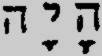
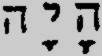
to read the pluperfect of the verb "to be" as had been. Thus Gen. 1.2 might have been rendered
"But the earth had been a
desolation.... etc.". However,
I think the im- plications of such a
rendering would be of questionable validity. In his book The Semantics
of Biblical Language, Professor Barr of the University of
Edinburgh has stated that the verb Gen. 1.2 because the
intention of the writer is that "the earth was waste and is no longer
so". Certainly this could be a
truth; but one wonders whether it is the
truth the author had in mind when he penned Gen. 1.2. And I
think, personally, that it is equally doubtful whether he meant that
"the earth had been waste - but was no longer so". Altogether, the least strain is placed
upon the original by rendering the verb accords well with the
position it occupies in the sentence and with general usage of the verb
elsewhere. We have mentioned that Driver
makes reference to Dr. Pusey in connection with this
question. Pusey, in his Lectures on Daniel, wrote in several places on
the subject. In his Introduction,
for example, he says,
"The insertion of the verb unless it be used to express
what was the condition of the earth in the past, previous to the
rest of the narrative, but in no conn- ection at all with what
preceded", I have already quoted a pass-
age very much like this one, but Pusey's reiteration of the principle involved serves here as an introduction to his much
fuller treatment of the circumstances surrounding the use of the
pluperfect in Hebrew which occurs somewhat later in his work on Daniel.
Thus he says subsequently: "There are cases in which words arranged as
they are here* (the subject being placed before the verb with the preceding 'and') form a parenthesis. But
then the context makes this quite clear." He then says: "The idiom chiefly adopted in
narrative to detach what follows from what precedes, is that which is
here employed, viz: the placing of the subject first and then the
past verb". Then he lists the following references as illustrations: Gen. 3.1 which introduces what follows but is unconnected
with the preceding; Gen.36.12; Jud.11.1; I Sam.3.1; II Ki.3.4; II
Ki.5.1; II Ki.7, 3; Num.32.1; Jud.20.38; Gen.41.56; Ezek.33.21; and I
Ki.14.30. Since these references (with one exception) do not
duplicate the series given in illustration of the same point by Driver,
it will be worth looking at each one briefly. Gen. 3.1: "Now the serpent had become more
subtle...." Gen. 36.12: "Meanwhile Timna had become concubine to
Eliphaz" Jud. 11.1: "Meanwhile Jepthah had become a
mighty man...." I Sam. 3.1: "Now the word of the Lord had become precious in those days...." II Ki.3.4: "Now Mesha, King of Moab, had
become a sheep mas- ter.... " II Ki.5.1; "Now Naaman had become a great
man". II Ki. 7.3: "Now four lepers had come to be
there". Num. 32.1: "Now great wealth had come to the
children of Reuben". Jud.20.38: "And an appointed sign had been
(arranged) by the men of Israel" (a construction very similar to
that of Gen.1.2). Gen. 41.56: "Now the famine had come to be over the face of the whole earth" (repeating a fact, antecedent to
the com- mand of Pharaoh). * He is
referring to Gen.1.2. Ezek.33.21: "And it
came to pass in the twelfth year of our capt- ivity, in the tenth month,
in the fifth day of the month, that one who had escaped
out of Jerusalem came to me saying, The City is
smitten! Now the hand of the Lord had been upon me in
the evening before that he that escaped had come, and had opened my
mouth...." I Ki.14.30: "Now there
had been a war between Rehoboam and Jeroboam...." (a construction
very similar to that of Gen. 1.2). In all these instances, as with those in Driver's list, the word order bears out the
essential point being made - namely, that the verb should be translated as a pluperfect, lending strong support to the view that the best
sense of the original Hebrew of Gen. 1.2 is that which results from rendering Thus, in summary, we have
three situations involving the verb "to be" in
English which are handled by Hebrew in different ways. The verb may be omitted:
the verb may be included and placed at the head of the sentence -
which is usual: and the verb may be in- cluded and placed after
its subject. In the first instance, the
sense is purely copulative. In the second, the meaning is
"to come to pass", "to happen", "to become" and "to be" in
the sense of existing or living. In the third, the tense is pluperfect; "had
been" or "had happened" or "had become". The instances illustrating the first or
simple copulative use are legion, every page of the
English Bible revealing many straightfor- ward examples, such as
"Darkness (was) upon the face of the deep" or "And God saw that it
(was) good" - in each of which the verb is omitted. By way of illustrating the second, we may cite: "Cain became a tiller of the soil",
"Eve became the mother of all living", "Lot's wife became a pillar of
salt", "And it became light", "And it became a custom in Israel",
etc., etc. Of the third usage, we may cite such passages as: "Now the serpent had become more
subtle"; "Now Nineveh had become a great city"; "Now
Nimrod had become a mighty hunter"; and, in my view of course, "Now the
earth had become a ruin and a desolation".* * In Appendix XV will be found further illustrations from the Old Testament
which show that the use of an in- verted word order to
express the pluperfect is by no means a rare circumstance but occurs quite frequently. Copyright © 1988 Evelyn White. All rights reserved
|

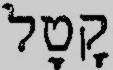 ) "to
kill" appear sin an appropriate form corresponding to "he
) "to
kill" appear sin an appropriate form corresponding to "he
 (Now + the
sub-
(Now + the
sub-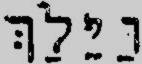 (verse
61)and
(verse
61)and 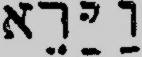 (verse 62) thus converge
 ).
). ) "Now Laban had gone away to
 )
) ). So
). So : ie., "Now the hand of the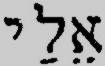
 ,
not
,
not
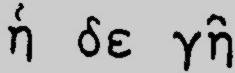 ,
ie., "But the earth...."
,
ie., "But the earth...." ,
Thayer remarks that it is a "participle adversative, distinctive,
,
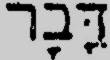
Thayer remarks that it is a "participle adversative, distinctive,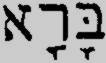 (create) in verse 1.
 used in